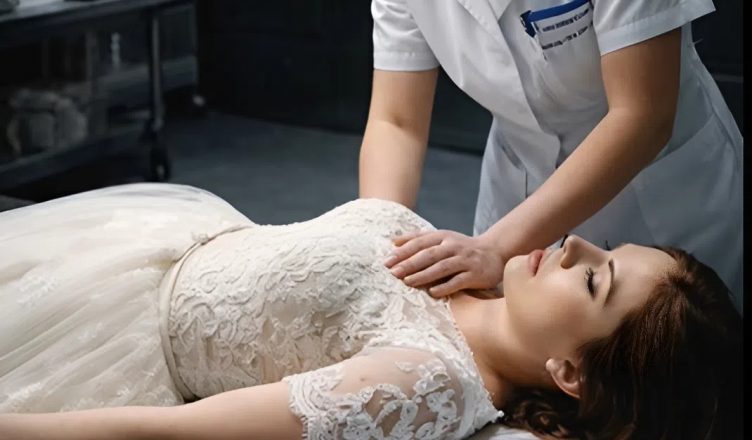
However, one of the morgue attendants noticed something strange: the bride’s cheeks were still rosy, almost like those of a living person, and it seemed as if her heart might still be beating faintly.
What happened next shocked everyone.
Early in the morning, an ambulance pulled up to the building. The siren suddenly fell silent, and several cars decorated with white ribbons and flowers slowly drove into the courtyard. A real wedding procession had arrived at the entrance of the morgue. People in formal clothes stood there in confusion — some were crying, others just stared ahead in silence.
The bride was brought inside on a stretcher. She was still wearing her lace wedding dress, her hair carefully styled, and her bouquet rested on her chest. The groom walked beside her. He wasn’t shouting or crying. He simply looked at her as if everything happening around them was a terrible mistake.
A morgue attendant watched the scene from the corridor. She had started working there only recently. At first, she had been afraid, and at night she dreamed about the long cold hallways. One day the senior doctor had told her something she would never forget:
“Don’t be afraid of the dead. Sometimes the living are far more dangerous.”
After that, she tried to treat the bodies calmly. They could no longer harm anyone.
When the relatives were escorted away, the bride’s body was left in a storage room. The doctor quickly checked the paperwork and said:
“The autopsy will be tomorrow. Finish your shift and go home.”
“Is the cause of death confirmed?” the attendant asked.
“Poisoning. Everything is clear and signed. Don’t worry about it.”
He left, and the room fell silent.
The attendant remained alone. She slowly walked closer to the table. The bride looked too peaceful. Her skin wasn’t gray, her lips weren’t blue, and her cheeks still had a soft pink color.
She frowned.
It is always cold in a morgue. Bodies usually become icy very quickly.
She touched the bride’s hand — and immediately pulled her fingers away.
The skin was warm.
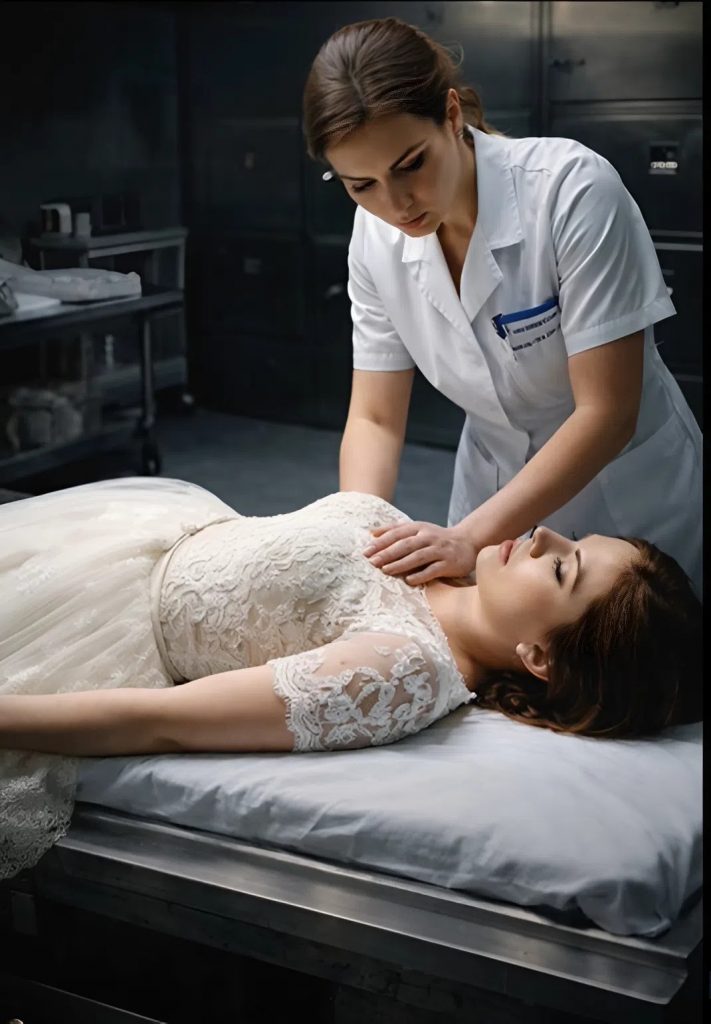
She touched it again, more carefully, as if she was afraid of being mistaken. Under her fingers the skin felt soft, almost alive. For a moment, it even seemed as if the bride’s chest moved slightly.
“That’s impossible…” she whispered.
She leaned down and pressed her ear against the bride’s chest.
In the deep silence of the morgue, she heard a faint, barely noticeable sound.
A heartbeat.
She stepped back in shock and covered her mouth with her hand. If she was right, it meant the young woman could have been buried alive.
Without hesitating, she rushed into the hallway and hurried toward the doctor’s office.
“Please come quickly! She’s alive!”
The doctor looked up from his papers with irritation.
“Who is alive?”
“The bride. Her body is warm and I heard her heart beating.”
He sighed heavily, set down his pen, and slowly stood up.
“Alright, let’s go. But if this is just your imagination, you’ll have to explain yourself.”
They walked into the room. The bride lay exactly as before — motionless, with her eyes closed.
The doctor put on gloves and began examining her. He checked her neck, looked at her pupils, and placed a stethoscope on her chest.
The attendant watched his face anxiously.
“Well?” she asked quietly.
The doctor straightened up.
“The body can remain warm for several hours. That’s normal. You probably mistook a muscle twitch for a pulse. After certain poisonings, post-mortem reactions can occur.”
“But I heard her heart.”
“You must have imagined it. We checked her carefully when she arrived. There was no cardiac activity.”
He removed his gloves and threw them into a bin.
“Don’t work yourself up. You’ll get used to this job.”
Then he left.
The attendant remained alone again.
She looked back at the bride. The young woman still seemed too alive to be dead.
A few minutes later, it looked as if the bride’s fingers moved ever so slightly.
The attendant quickly leaned closer.
“If you can hear me… give me a sign,” she whispered.
There was no response.
She stood there, trying to convince herself that the doctor was right — that everything she felt was just her imagination.
But deep inside she felt something else.
That night she didn’t go home right away. She returned to the room once more and checked again. The skin remained warm far longer than it should have.
That was when she made a decision.
She secretly placed a small camera in the corner of the room, pointing it toward the table. She didn’t tell anyone.
The next morning she arrived earlier than everyone else, locked herself in a small office, and started watching the recording.
And a few minutes later, she saw something on the screen that made her blood run cold…