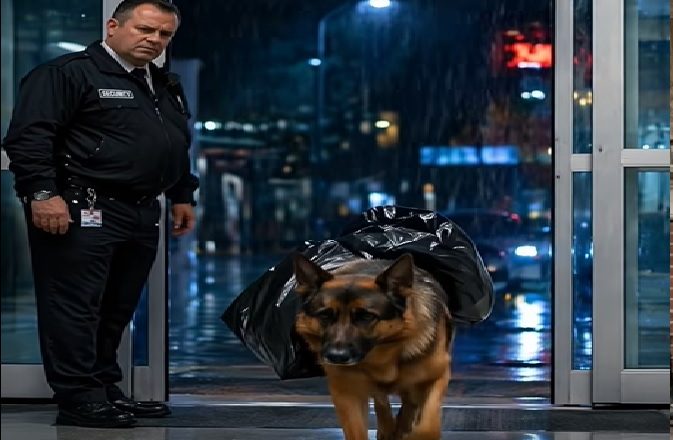
Ripples still moved across the puddles, and the wind pushed scraps of paper through the empty parking lot. There was no sign of the dog. No shadow, no movement in the darkness. As if it had never been there at all.
The nurse stood at the entrance for a long time, staring into the night. Her hands were still trembling after everything that had happened. Over the years, she had seen accidents, fires, difficult births, heartbreaking losses, and miraculous recoveries. But never anything like this.
Inside the ward, everyone spoke of only one thing.
The security guard, who had first tried to drive the dog away, sat silently with his head lowered. He could not forgive himself for nearly sending away the one creature that had come begging for help. The others kept replaying the moment the bag had been opened, as if they still could not believe what they had seen.
Meanwhile, the baby remained in intensive care. His condition was still serious: severe hypothermia, weak breathing, and signs of exhaustion. Yet his tiny heart continued to beat bravely. A small heart, but full of determination.
The doctors did not leave his side for a moment.
By morning, the police had arrived at the hospital. They needed to find out who had abandoned the child, how he had ended up on the edge of the city, and where the dog had come from. They examined the bag, the old blanket, and the ropes. On the fabric they found mud, leaves, and traces of grass — all leading toward an abandoned lot near old warehouses.
A patrol was sent there immediately.
What they discovered shocked even the most experienced officers. In the wet grass was a hollow place where something had lain pressed against the ground for hours. Around it were dozens of large paw prints. The dog had not only found the child. It had kept him warm for hours, shielding him with its own body from the wind and rain.
One of the officers later admitted that tears filled his eyes.
The news spread through the city at incredible speed. People brought toys, clothes, money, and baby supplies to the hospital. Some left notes saying, “For the child saved by an angel.” Others wrote, “Find that dog. It is a hero.”
But no one could find it.
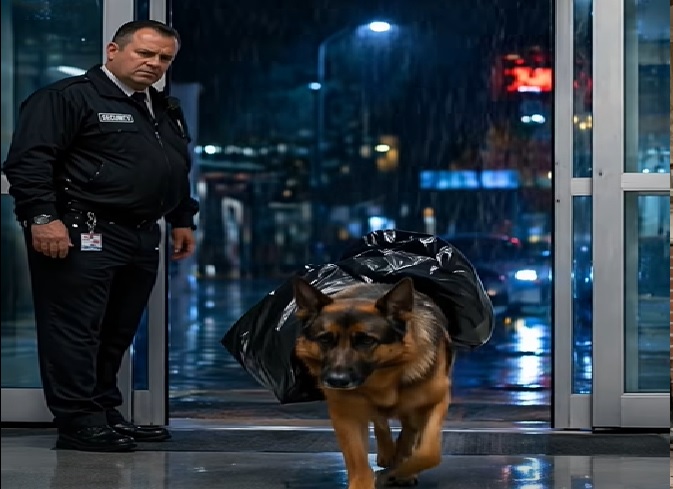
Volunteers searched streets, yards, warehouses, and underpasses. They showed security footage of the soaked German Shepherd carrying a bag tied across its back. Some claimed they had seen a similar dog near the market. Others swore it lived by the railway tracks. But every lead ended in nothing.
Three days later, the baby opened his eyes for the first time.
The nurse who had untied the bag first could not hold back her tears. She took the tiny hand in hers and whispered softly:
“You truly wanted to live… and someone truly wanted to save you.”
Later, the boy was given the temporary name Arsen, a symbol of strength and endurance. The name suited him perfectly.
But the real surprise came a week later.
Late that evening, a familiar bark echoed outside the hospital once again.
The staff rushed out almost at the same time.
Sitting at the entrance was the same dog. Dirty, thinner than before, its paws scratched and wounded. It stared at the doors while slowly wagging its tail.
The nurse dropped to her knees and began to cry.
“You came back…”
The dog calmly allowed itself to be stroked, but its eyes remained fixed on the building. They led it inside. When the room door opened, it stepped in slowly and stopped.
The baby was sleeping.
The German Shepherd lay down beside the crib, rested its head on its paws, and closed its eyes. For the first time in days, it looked peaceful.
As if only now it understood that the child was safe.
Later, veterinarians found an old scar along its side, signs of long life on the streets, and deep exhaustion. It had no microchip. No owner was ever found.
Then the hospital made a decision the whole city supported.
The dog would stay there permanently.
The staff prepared a place for it near the nurses’ station, bought a bed, food, and toys. They named it Storm — in memory of the night it ran through the downpour and changed the fate of many lives.
And every time Storm walked past the children’s ward, it would pause beside little Arsen’s crib and look at him with wise, gentle eyes.
As if making sure everything was still all right.
From that day on, no one doubted that sometimes the most human acts are carried out by those who cannot speak.