After my father’s funeral, I thought the hardest part was already behind me. I was wrong.
A little more than two weeks had passed. I was slowly going through his belongings, answering calls from relatives, and trying to get used to the strange thought that I could still dial his number, but no one would ever answer again.
On Saturday morning, my phone rang. I didn’t recognize the number.
“Are you Anna? Viktor Sergeyevich’s daughter?”
I immediately became cautious.
“Yes. Who is this?”
The man introduced himself as Mikhail and said he had known my father for many years. His name meant nothing to me. In my entire life, I had never heard my father mention anyone by that name.
“Your father left something with me for you. He asked me to give it to you only after his death.”
At first, I thought there had been some mistake, or perhaps it was even an attempt to scam me. But the man mentioned several details that a stranger could hardly have known. He knew about my father’s old watch with its cracked glass and about the café near the train station where my father went every Friday.
I knew about those trips. Dad always said he was meeting an old friend there. I had never asked who that friend was.
We agreed to meet at that very café.
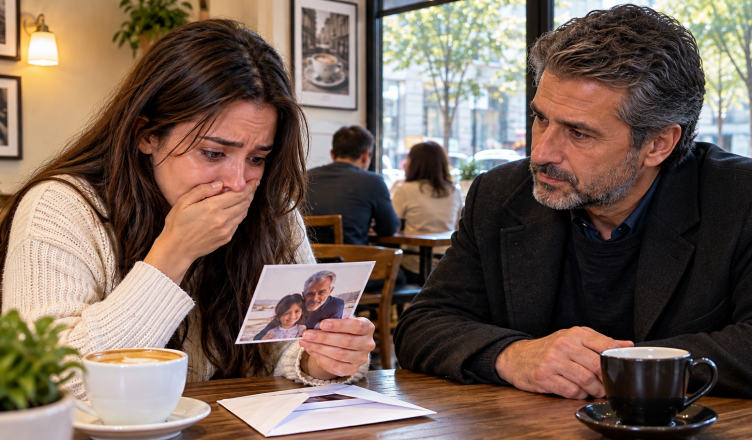
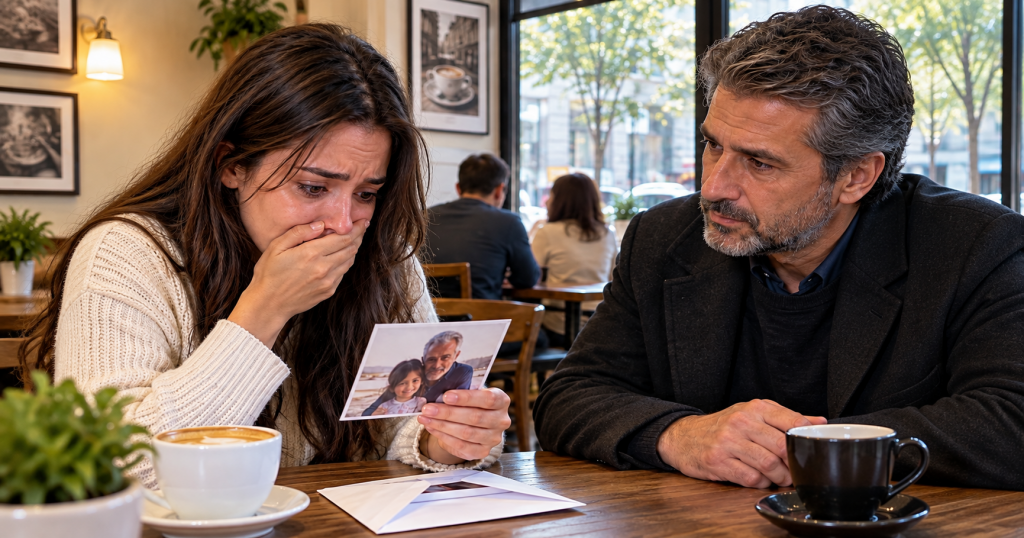
Mikhail was a man in his early sixties. When I arrived, he was already sitting at a table in the back. A thick, yellowed envelope lay in front of him.
After a few polite words, he pushed it toward me.
My name was written across the front in my father’s handwriting.
“He gave this to me five years ago,” Mikhail said. “He made me promise that under no circumstances would I give it to you while he was still alive.”
“Why?”
The man lowered his eyes.
“I think the answer is inside.”
I opened the envelope.
There were several photographs, an old key, and a sheet of paper folded into quarters.
Almost without thinking, I pulled out the first photograph.
And froze.
It was my father.
He was much younger than I remembered him: thick dark hair, a denim jacket, and a wide smile.
An unfamiliar woman stood beside him.
But she wasn’t the reason my hands began to tremble.
The woman was holding a little girl in her arms.
My father had written a date on the back. The photograph was more than thirty years old.
Underneath, there were only three words:
“Lena. One year old.”
“Who is she?” I asked.
Mikhail shook his head.
“Your father asked me not to explain anything.”
I took out the remaining photographs.
They all showed the same girl: first as a small child, then as a schoolgirl, a teenager, and finally a young woman. In several of the pictures, my father was standing beside her.
Judging by the dates, the photographs had been taken over a period of almost twenty years.
It meant that my father had an entire part of his life that our family knew absolutely nothing about.
At the bottom of the envelope was a letter.
“Anna, if you are reading this, it means I am no longer here. Many times I wanted to tell you everything myself, but every time I postponed the conversation. Maybe it was cowardice. Maybe I was simply afraid of destroying something that could no longer be repaired.”
My father went on to explain that long before he met my mother, he had been in a serious relationship with a woman named Marina. They separated after a bitter argument, and soon afterward, my father moved to another city.
He didn’t learn until much later that Marina had been pregnant when they separated.
That was how Lena came into the world.
I read that part several times.
My father had another daughter.
My sister.
According to his letter, he had tried to be part of Lena’s life, but his relationship with Marina remained complicated. When he met my mother and started a new family, the situation became even more difficult.
He chose to remain silent.
Yet he could never completely disappear from his older daughter’s life. He visited her from time to time, helped her financially, and was present for some of the important moments in her life.
That was why he went to the same café every Friday.
He met Mikhail there, who had once been a close friend of Marina’s and helped them stay in contact.
I felt anger rising inside me.
Why had my father never told me?
Why had he allowed me to spend decades believing that I was his only child?
But the letter wasn’t over.
My father wrote that Marina had died several years earlier. After her death, he tried to rebuild his relationship with Lena, but she didn’t want to become part of our family.
“She knows about you,” my father wrote. “And I can’t blame her for not wanting to enter your life. To her, I was a man who always arrived and then disappeared again.”
That was when I understood what the old key was for.
The letter contained the location of a small storage locker at the old train station. My father said he had left a box there containing documents and letters that would help me understand everything without having to rely on someone else’s explanation.
An hour later, Mikhail and I were standing in front of a small metal door.
The key fit.
Inside was a small wooden box.
I expected to find more photographs or documents.
Instead, another envelope was lying on top.
Written across it were the words:
“For Anna. From Lena.”
I looked at Mikhail.
“She knew my father was preparing all of this?”
“Yes.”
I opened the letter.
Lena had written only a few paragraphs. There were no accusations and no dramatic confessions. She had known about me for almost her entire life, but she had never wanted to interfere with another family.
Several times, my father had suggested introducing us.
Each time, she had refused.
At the end of the letter was a sentence that changed the meaning of everything:
“If you ever want to know me as more than a face in these photographs, Mikhail knows how to find me.”
I stood in front of the open locker for a long time.
In the space of just a few hours, my father had changed from the man I thought I knew completely into someone filled with mistakes, fears, and secrets.
Part of me wanted to be angry with him.
Another part desperately wanted to hear his explanation.
But there was no one left to ask.
Three days later, I called Mikhail.
“Do you have Lena’s phone number?”
He was silent for a moment.
“Yes. But the decision has to be yours.”
I wrote down the number and spent almost an hour staring at my phone screen.
Finally, I typed a single sentence:
“Hello. My name is Anna. I think it’s time we met.”
Her reply didn’t arrive until that evening.
“I’ve been waiting for this message for many years.”
A week later, we met at the same café.
When Lena walked through the door, I didn’t need anyone to introduce her.
She had our father’s eyes.
And when she became nervous, she slightly tilted her head in exactly the same way he used to.
I had seen that gesture thousands of times.
We didn’t run into each other’s arms. There were too many unknowns between us for that.
We simply sat across from one another.
She ordered tea.
I ordered coffee.
And then we began to talk.
For the first time in our lives, we told each other about our father — the same man, yet someone each of us had known in a completely different way.
Only then did I understand why he had kept all those photographs.
Perhaps he hoped that after his death, we would manage to do what he had never found the courage to do while he was alive: open a door between two halves of the same family.
I couldn’t forgive him immediately.
Perhaps some actions can never be completely justified. But that envelope made me understand something else.
Family secrets don’t always begin with one enormous lie.
Sometimes they are built from countless small decisions to remain silent today and promise yourself that you will explain everything tomorrow.
Until one day, you discover that “tomorrow” will never come.