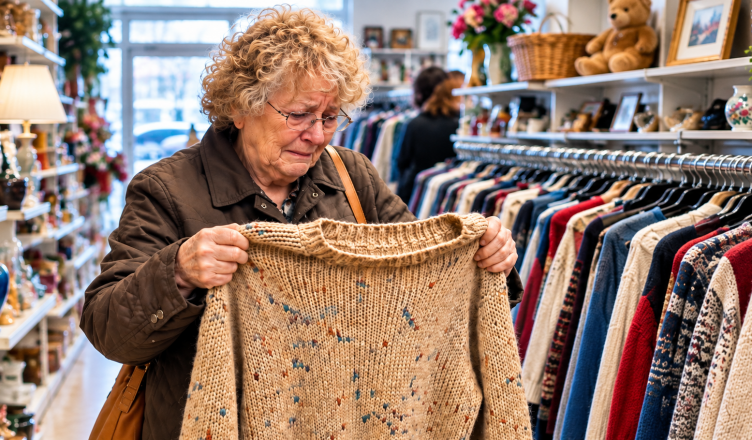
We ended up in that store completely by accident. We needed some old flowerpots for the garden, and our neighbor recommended a small thrift store on the outskirts of town. He said you could find good things there for next to nothing.
My wife, Margaret, had always liked places like that. While I looked through the gardening tools, she slowly wandered between shelves filled with dishes, books, and clothing.
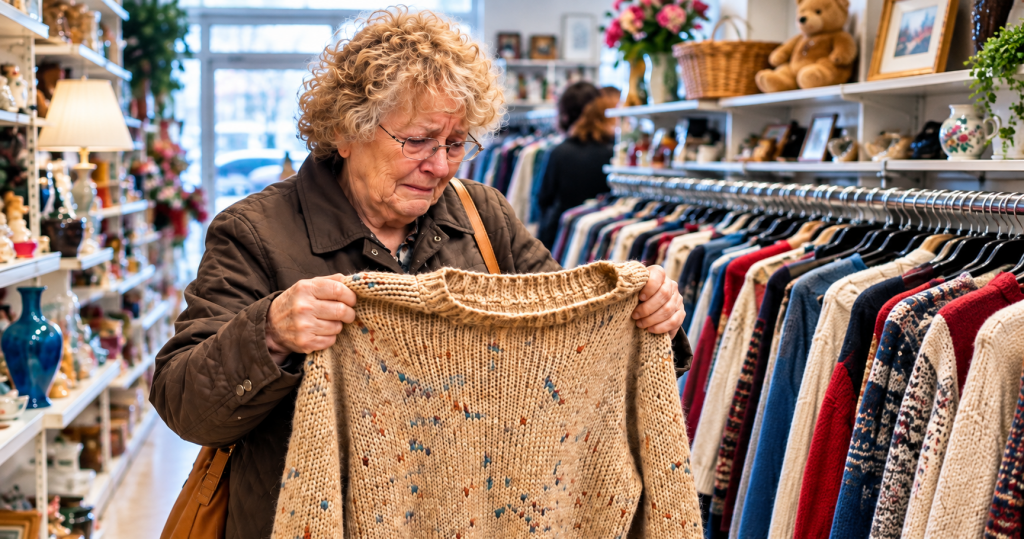
Then I noticed that she had stopped.
She was standing in front of a rack of children’s clothes, staring at several knitted sweaters.
I walked closer and immediately understood what had happened.
There was no mistaking those sweaters.
Margaret had knitted them with her own hands.
Gifts That Took Weeks to Make
My wife learned to knit when she was a teenager. After our grandchildren were born, her hobby gradually became a special family tradition.
Before every Christmas, she began preparing months in advance. For our oldest granddaughter, she chose softer, more understated colors because she knew that was what she liked. For our younger grandson, she created brighter patterns. One sweater had tiny trees, another had snowflakes, and on another she had carefully stitched the child’s initials inside the collar.
Sometimes a single sweater took several weeks to finish.
I often watched Margaret sit by the window in the evening, put on her glasses, and continue knitting after a long day. If she noticed a mistake, she would unravel several rows and start that section again.
She never talked about how many hours she had spent making them.
At birthdays or Christmas, she simply handed over the carefully wrapped gift and smiled as she watched the child open it.
As the grandchildren grew older, however, their excitement began to fade. Phones, expensive sneakers, gaming consoles, and other things became more interesting. A handmade sweater could hardly compete.
But Margaret kept knitting.
She believed that one day the children would understand what those gifts really meant.
And now several of those sweaters were hanging in a thrift store.
She Said It Was Fine
Margaret carefully took one sweater off the hanger.
Inside the collar was a small letter she had embroidered by hand years earlier.
There was no doubt.
«Maybe they just outgrew them,» she said quietly.
I didn’t answer.
We both knew the children had grown. There was nothing wrong with donating clothes that were no longer needed. In fact, those sweaters could now be useful to another family.
That wasn’t what hurt.
What hurt was that no one had even told Margaret they no longer needed them.
They could have returned the sweaters to her. They could have asked whether she wanted to keep one or two. They could simply have explained that the children had outgrown them.
To Margaret, they weren’t just clothes.
They represented dozens of evenings of her life.
I watched her turn away and pretend to examine another shelf. Then she quickly wiped her cheek with her hand.
She didn’t want me to see her tears.
We bought every one of the sweaters.
Margaret barely spoke on the way home.
Then I Had an Idea
My first reaction was anger.
I wanted to call our children immediately and demand an explanation. But after a few hours, I realized that shouting wouldn’t change anything. The grandchildren would hear accusations, become defensive, and a week later the whole conversation would probably be forgotten.
I wanted something different.
I wanted them to understand why their grandmother had been hurt.
A few weeks later, we were having a family dinner. Margaret usually organized everything herself, but this time I took care of it.
I placed the sweaters we had found in a large box. Beside them, I put several balls of yarn, knitting needles, and a few old photographs.
In the pictures, our grandchildren were still very young. In one, our grandson was holding a toy car while wearing a striped sweater. In another, our granddaughter was laughing in a sweater her grandmother had finished just before her birthday.
When the whole family arrived, I placed the box in the middle of the room.
The grandchildren looked surprised.
They were expecting ordinary gifts.
I opened the box.
At first, no one understood.
Then our oldest granddaughter recognized her sweater.
«Where did you find this?»
I told her the name of the store.
The room fell silent.
A Conversation We Should Have Had Long Ago
I didn’t raise my voice.
Instead, I asked each of them to pick up a ball of yarn.
Then I explained approximately how much time their grandmother had spent making a single sweater. I told them how she chose colors specifically for each child, redid patterns when they weren’t right, and sometimes sat knitting late into the night.
«You had every right to stop wearing these clothes,» I said. «You grew up. But there’s a difference between an old sweater and a gift into which someone has put a part of their life.»
No one argued.
One of the grandchildren admitted that they had been clearing out their closets with their parents and collecting clothes for charity. They hadn’t paid much attention to exactly what went into the donation bags.
To them, it had simply been a closet cleanout.
To Margaret, it meant something completely different.
Then something happened that I hadn’t expected.
Our youngest granddaughter walked over to her grandmother and asked:
«Will you teach me how to knit?»
Margaret stared at her for a moment, as if she wasn’t sure she had heard correctly.
Then she smiled.
The First Crooked Scarf
A week later, our granddaughter came back.
The first lesson was a disaster. The stitches were all different sizes, the yarn kept slipping from her hands, and the future scarf looked more like a strange woolen rope.
Margaret laughed.
For the first time since our visit to the thrift store, I saw her genuinely happy again.
A few months later, our granddaughter finished her first scarf. It was uneven, too wide at one end and too narrow at the other.
But she refused to fix it.
She said she wanted to keep it exactly as she had made it.
Now she understood how much patience was hidden behind every handmade item.
The other grandchildren changed too. There was no miraculous transformation overnight, but they gradually began asking their grandmother more questions about her knitting, taking an interest in old family photographs, and treating sentimental belongings with greater care.
Margaret never gave away the sweaters we found in the store.
One now lies in an old wooden chest with our family photographs. She unraveled another and used the yarn to make a new blanket. Several others she kept exactly as they were.
Sometimes things really do lose their practical value. Children outgrow their clothes, toys end up in the attic, and gifts no longer match our tastes.
But some objects carry something that can never be seen on a price tag: hours of another person’s life, their care, and their desire to make someone they love happy.
That was what I wanted our grandchildren to understand.
Not that they had to keep every old sweater forever.
But that before letting go of a gift, they should pause for just a moment and remember the person who once made it especially for them.