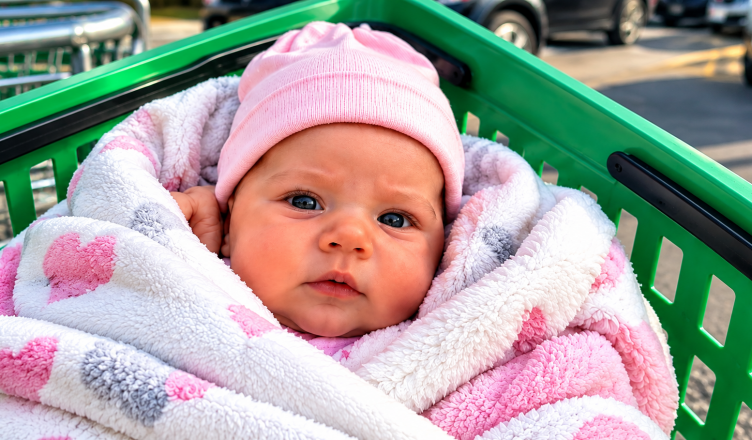
Sometimes a single unexpected decision changes not just one life, but an entire family forever. On that autumn evening, seventeen-year-old Laura could have taken a different route to the car. She could have ignored the abandoned shopping cart at the far end of the parking lot. She could have convinced herself that the strange sound she heard was only her imagination.
But she stopped.
Laura was leaving the store when she noticed that one of the abandoned shopping carts was moving slightly. There was almost no wind. She took a few steps toward it and heard a faint sound that resembled crying.
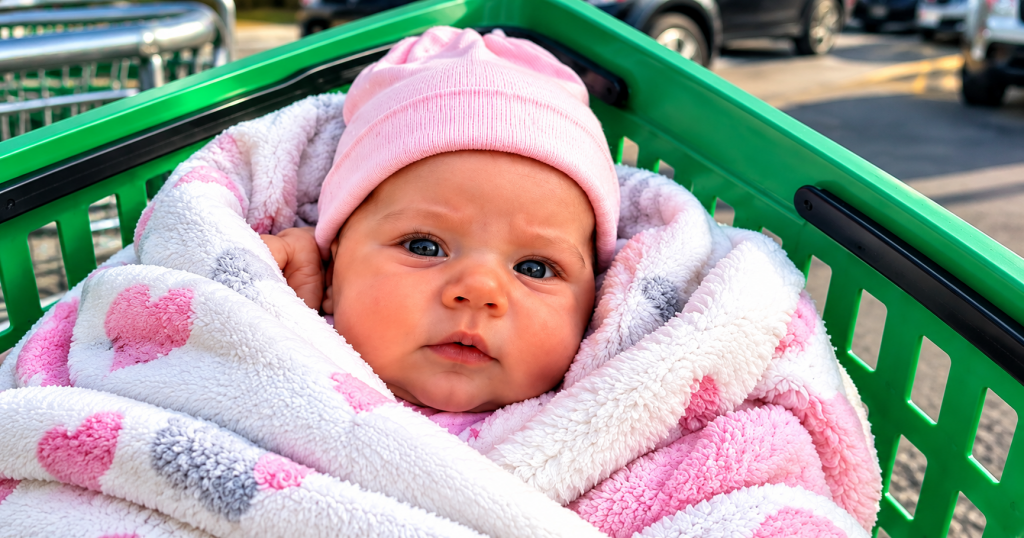
There was a bundle inside.
At first, Laura thought someone had left a toy behind. But when she lifted the edge of the thin blanket, she saw a tiny face.
A newborn baby girl was lying there.
Laura immediately cried out for help. Store employees called emergency services, and the baby was rushed to the hospital. She was dangerously cold, but the doctors were able to provide the care she needed in time.
For our family, the story could have ended there. Laura could have come home, the baby could have been placed in the care of social services, and years later we might have remembered that evening simply as an extraordinary event.
But things turned out very differently.
I worked as a nurse, so I understood how uncertain the child’s future could be. My husband Robert and I talked about what had happened for a long time. Eventually, we began asking whether it might be possible for us to become the little girl’s foster family.
The process was far more complicated than we had imagined. There were background checks, paperwork, interviews with professionals, and months of waiting. Meanwhile, the police continued trying to identify the baby’s parents.
Very little information was shared with us. The investigation continued, but the little girl’s origins remained a mystery.
Eventually, she came to live in our home.
We named her Emily.
I still remember the first evening I placed her in her little crib. Laura sat beside her and watched the sleeping baby for a long time.
“Can you imagine what would have happened if I’d walked to the car another way that night?” she asked.
I didn’t know how to answer.
The years passed. Emily grew into a curious, energetic, and incredibly stubborn girl. She loved drawing animals, hated oatmeal, and constantly asked questions that adults couldn’t always answer.
We never hid the truth from her.
She knew that she had been found as a baby. She knew Laura had been the first person to hear her crying. She also knew that we didn’t have answers to every question about where she had come from.
When Emily was about eight years old, she asked me something for the first time that I had always feared hearing.
“Didn’t my real mother want me?”
I explained that we simply didn’t know what had happened that day. People can find themselves overwhelmed by desperation, fear, or circumstances that others know nothing about. It would have been wrong for us to invent an explanation and turn an unknown woman into either a villain or a victim.
Emily thought about this for a moment.
“What if she comes here someday?” she asked.
I told her that if that ever happened, we would try to discover the truth together.
I thought that conversation was still many years away.
I was wrong.
Emily was eleven when the doorbell rang one afternoon. I was expecting a delivery, so I opened the door without looking through the window first.
A woman in her mid-thirties was standing on the porch. She looked as though she had spent a long time gathering the courage to press the doorbell.
“Are you Margaret?” she asked.
I nodded.
The woman remained silent for several seconds.
“I came because of Emily.”
My hands suddenly went cold.
I asked who she was.
She looked directly into my eyes.
“I’m her biological mother.”
Anyone in my position would probably have been shocked. But it wasn’t only her words that stunned me.
I knew this woman.
I had seen her face eleven years earlier.
Her name was Rachel.
Several weeks before that night in the parking lot, she had appeared at the hospital where I worked at the time. I hadn’t treated her and knew nothing about the details of her condition. I had simply seen a young pregnant woman in the hallway a few times.
Yet somehow, I had remembered her face.
And now she was standing at my front door.
I didn’t allow her to meet Emily immediately. There was too much that needed to be verified. A claim alone wasn’t enough, especially when a child was involved.
We contacted the appropriate authorities and spoke with a lawyer. The woman’s identity and her story had to be officially confirmed. Only after the necessary procedures were completed did we learn that Rachel truly was Emily’s biological mother.
But the most difficult question remained.
Why?
When we were finally able to sit down and talk calmly, Rachel told me her story.
She had been twenty-four when her daughter was born. She had no permanent home, almost no money, and little support from the man whose child she was carrying. Fear gradually turned into panic. After giving birth, she became convinced that she couldn’t provide her daughter with a safe life.
That did not make leaving a newborn in a shopping cart right or safe. Rachel herself never claimed that it did. She wasn’t telling her story to excuse what she had done.
According to her, she had lived with the memory of that day for years.
Eventually, her life changed. She found steady work, continued her education, and managed to build a more stable life. But confronting her past proved much harder than she had expected.
She hadn’t come to demand her daughter back.
She wanted to know whether her child was alive, whether she was healthy, and whether she had grown up in a family that loved her.
The hardest part was deciding what to tell Emily.
We asked a professional for guidance so that the truth wouldn’t become an overwhelming emotional shock for her. Emily had a right to know where she came from, but the adults around her had no right to force her into making immediate decisions or choosing between people.
When we finally told her the truth, she remained silent for a long time.
Then she asked a question none of us expected.
“Did she know Laura was the one who found me?”
I told her that she knew now.
The first meeting didn’t happen immediately. Emily needed to decide for herself whether she was ready. Several weeks later, she agreed.
Rachel entered the room quietly. She didn’t rush toward Emily or try to hug her. She simply sat across from her.
“I don’t know what I’m supposed to say to you,” Rachel said.
Emily looked at her.
“Then tell me the truth.”
Their conversation lasted nearly two hours.
It didn’t erase the past. It couldn’t remove eleven years of unanswered questions, and it didn’t transform a complicated story into a perfect fairy tale.
But afterward, the past was no longer an empty space filled only with uncertainty.
Emily remained our daughter. Laura was still the older sister who had once heard an almost invisible baby’s cry in the middle of a huge parking lot. And Rachel gradually became part of Emily’s story—not in place of the family that had raised her, but alongside it, as much as Emily herself was comfortable allowing.
Over time, I came to understand something important.
That evening, Laura didn’t simply save a baby who had been left in a shopping cart. She gave a child she didn’t know the chance to grow up and one day decide for herself what place the people from her past would have in her life.
We often think a family begins with birth.
Sometimes, however, it begins the moment one person notices another, stops, and chooses not to walk away.