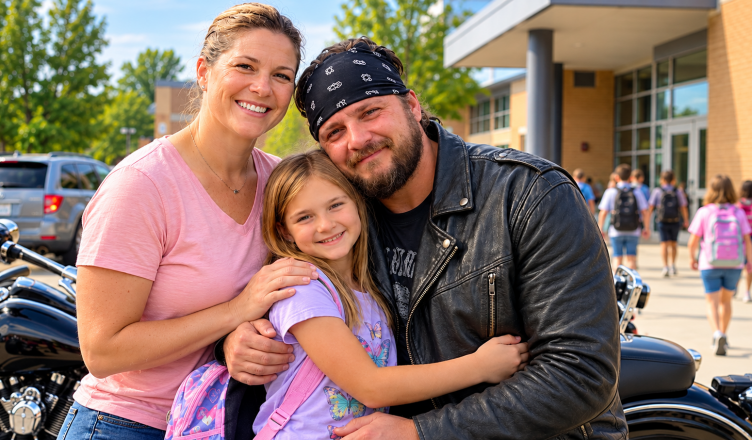
When a man with a heavy motorcycle, a leather jacket, and a habit of coming home late at night moved into the house across the street, my husband almost immediately decided that it would be better to keep our distance from our new neighbor.
His name was Mark. He was around fifty, lived alone, rarely spoke to anyone, and every morning he rolled a large black motorcycle out of his garage. Whenever we crossed paths, Mark usually limited himself to a brief greeting. He had never done anything wrong to us, yet my husband remained suspicious of him.
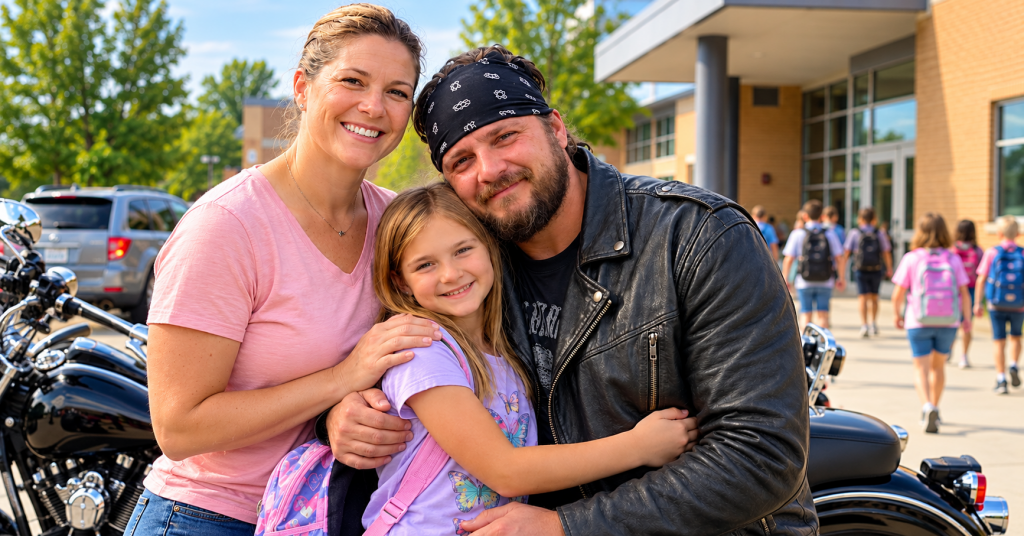
Things changed even more after Mark became acquainted with our eight-year-old daughter, Lily.
One afternoon, I saw them together outside our house. Lily was walking with her backpack over her shoulders, excitedly telling him something, while Mark walked beside her, pushing the bicycle he usually rode to the store.
“Why did he walk you home?” my husband asked as soon as our daughter stepped through the door.
Lily looked surprised.
“We were just walking together. He saw me near the school.”
That explanation wasn’t enough for my husband.
Over the next few days, the same thing happened again. Sometimes Mark appeared near the school just as classes were ending, and then he would walk Lily almost all the way to our front door.
My husband became increasingly uneasy.
“I don’t like this,” he said one evening. “We know almost nothing about him. Why is a grown man constantly hanging around our daughter?”
I tried to calm him down. Mark had never entered our home without being invited, never offered to take Lily anywhere, and had never done anything obviously inappropriate. Still, I understood my husband’s concern. When it comes to a child, parents have every right to ask questions.
Eventually, he insisted that I speak to our neighbor.
I postponed the conversation for several days. I didn’t want to accuse someone simply because he looked different from most of the people on our quiet street. At the same time, I couldn’t simply ignore my husband’s concerns.
Then the phone rang.
It was Lily’s teacher.
Her voice sounded unusually serious.
“I need to speak with you about the man who sometimes meets your daughter after school.”
My hands suddenly went cold.
My first thought was that my husband had been right all along.
The teacher asked me to come to the school. I called my husband, and half an hour later we were sitting across from her.
“It’s about your neighbor, Mark,” she began.
My husband immediately tensed.
But what she told us next was nothing like what we had expected.
Several weeks earlier, the teacher had noticed an unfamiliar car regularly appearing near the school. It usually stopped in roughly the same place. At first, no one paid much attention to it. There were houses and shops nearby, and parents were constantly arriving to pick up their children.
Mark, however, had noticed something else.
The driver had apparently tried several times to speak to students who were leaving school alone.
Mark didn’t confront the stranger or try to investigate the situation himself. Instead, he reported what he had observed to members of the school staff.
The teacher explained that the school administration had begun watching the area around the entrance more carefully and had reminded parents to review basic safety rules with their children.
But there was another important detail.
Lily had left school alone several times.
Usually, either her father or I picked her up, but work occasionally made us late. On those days, Lily knew she was supposed to wait for us near the entrance. One afternoon, however, she decided to walk home by herself.
That was when the driver of the unfamiliar car tried to speak to her.
Mark happened to be nearby.
He didn’t stop to find out what the stranger wanted. He simply walked over to Lily, greeted her as though they had arranged to meet, and stayed beside her.
The car drove away shortly afterward.
From that day on, Mark deliberately passed by the school several times around the time classes ended. Whenever he saw Lily alone, he walked with her as far as our street.
My husband and I sat there in silence.
All this time, he had considered Mark a possible danger, when in reality our neighbor had noticed something that we ourselves had failed to see.
“Why didn’t he tell us?” my husband finally asked.
The teacher explained that Mark hadn’t wanted to frighten Lily. He had assumed the school would contact the parents once staff members had a clearer understanding of the situation.
My husband barely spoke on the way home.
That evening, he went across the street and knocked on Mark’s door himself.
I watched them through the window. At first, they stood several steps apart on the porch. My husband spoke while Mark listened. Then our neighbor replied.
A few minutes later, my husband held out his hand.
Later, he admitted that he felt embarrassed.
“I created an entire story about him in my head even though I hardly knew anything about him.”
The incident changed not only the way we saw our neighbor but also the rules in our family.
We explained to Lily that she should never leave school alone if we had arranged to pick her up. If her parents were late, she should remain near a teacher or another member of the school staff. We also decided to make sure the school always knew exactly who was authorized to pick up our daughter.
But the experience taught us something else as well.
Parents need to be cautious. If an unfamiliar adult repeatedly appears around a child, it is reasonable to find out what is happening. But being cautious and making a premature accusation are not the same thing.
A person’s appearance, clothing, profession, vehicle, or quiet personality proves nothing by itself. In the same way, a friendly appearance is no guarantee of safety. Instead of relying on assumptions, it is better to establish the facts: talk to the child, speak with teachers, and, when circumstances allow it to be done safely, communicate with the person involved.
After some time, Mark was no longer “that strange biker who lives across the street.”
We finally got to know the person we had never really tried to understand.
And one morning, my husband admitted that when he now hears the familiar sound of Mark’s motorcycle outside the window, he feels something completely different.
Not fear.
Gratitude.