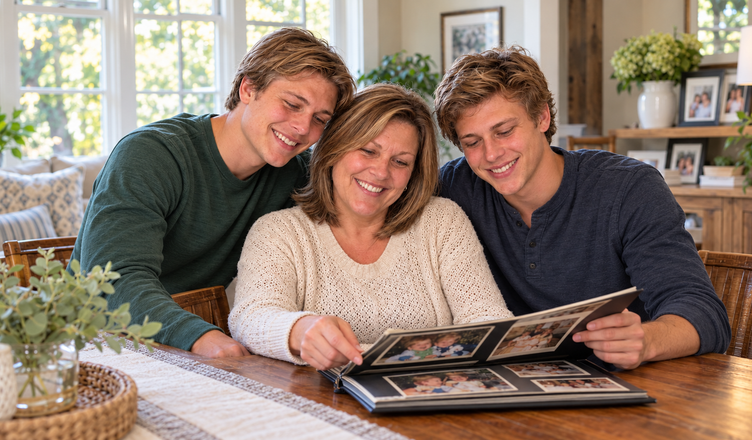
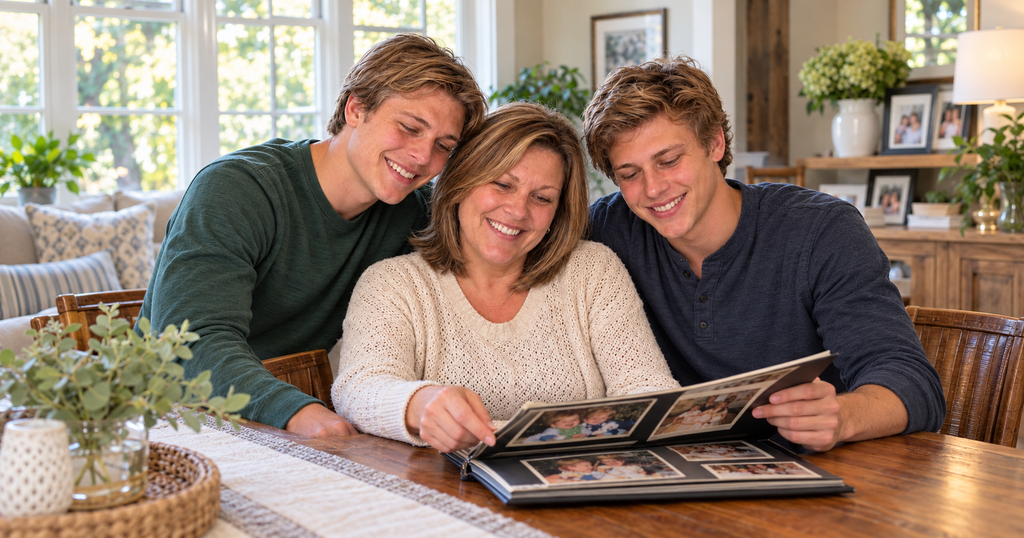
My sons’ eighteenth birthday was supposed to be an ordinary family celebration. We had ordered a cake in advance, taken out old photographs, and invited a few close friends. I tried not to think about the fact that this day had always carried two very different meanings for me.
Once, I had given birth to three boys.
Back then, our home seemed far too small for three cribs, three sets of bottles, and endless loads of laundry. We barely slept, constantly mixed up their clothes, and laughed about the fact that we had learned to tell our sons apart by the way each of them cried.
But six months later, everything changed.
One of the boys died after a serious illness.
From that moment on, our family seemed divided into two parts: life before that winter and life after it.
The two surviving boys grew up healthy, loud, and completely different in personality. They knew about their brother from an early age. We never hid the truth from them. In the family photographs from their first months of life, there were always three babies, so sooner or later the questions would have come anyway.
When they were little, they accepted the story almost calmly. To them, their brother was mostly someone who existed in old photographs.
As they grew older, that changed.
When they were about twelve, one of them asked me one day:
“What do you think he would be like now?”
I could not answer.
After that, the question returned from time to time.
Every year on their birthday, I automatically imagined not two boys growing older, but three.
That was why, on the day they turned eighteen, I woke up before everyone else.
At around eight in the morning, I went to open the front door because I was expecting a grocery delivery.
A small cardboard box was sitting on the doorstep.
There was no courier in sight.
The box had no return address and no delivery label.
Only a few words written across the top in black marker:
“Happy Birthday, Brothers.”
I stared at those words for several seconds.
Then I picked up the box.
It was light.
My first thought was that one of my sons’ friends had arranged a surprise. But almost immediately, I noticed something strange.
Under the lid was an old photograph.
I recognized it at once.
All three of my sons were in the picture as babies.
It had been taken at home about a month before one of them died.
But I was certain I had never given anyone a copy.
Under the photograph was a small plastic container, several folded sheets of paper, and an envelope.
My name was written on the envelope.
I felt my hands begin to shake.
The handwriting looked familiar.
Nearly twenty years earlier, while one of my sons was in the hospital, a young nurse had often been with us. Her name was Anna. She worked in the children’s ward and frequently stayed after her shift to help parents.
After our baby died, we spoke a few times.
Then we lost contact.
I opened the envelope.
Inside was a letter.
Anna wrote that she had kept several things connected to our son for many years. After his death, a few personal belongings had remained at the hospital and were supposed to be returned to the family.
But at that time, we were barely able to speak to anyone normally. I hardly remember the funeral itself.
According to Anna, my husband had asked her to keep some of the belongings.
He told her that one day he wanted them to be given to the two brothers.
I read that sentence several times.
My husband had died six years earlier.
He had never told me about any of this.
Inside the box was a small hospital bracelet with our son’s name on it.
Beside it was a tiny blue cap.
And there was another photograph.
In it, my husband was sitting in a hospital room holding all three boys in his arms at once.
I had never seen that photograph before.
But the greatest surprise was the final sheet of paper.
It was a short letter written in my husband’s handwriting.
Judging by the date, he had written it shortly after our baby died.
It was addressed to the two surviving boys.
He wrote that he did not know when they would read those words. Perhaps when they were teenagers. Perhaps when they were already grown men.
He asked them never to think of themselves as “two out of three.”
“You do not have to live your brother’s life for him,” he wrote. “You do not have to be three times stronger, more successful, or happier. Just live your own lives. That is enough.”
I sat alone in the kitchen for several minutes.
Then I heard footsteps.
The boys came downstairs and immediately noticed the box.
I could have hidden it.
But I realized that was exactly what my husband had never wanted.
We sat down at the table.
First, I showed them the photograph.
Then the hospital bracelet.
And finally, I read the letter.
My sons usually joke with each other constantly. But in that moment, both of them were silent.
One stared at the photograph of his father for a long time.
The other held the tiny cap in his hands.
Finally, he asked:
“So Dad was thinking about this all along?”
I nodded.
Later, we found Anna’s phone number at the end of the letter.
I called her.
She answered almost immediately.
It turned out that she really had left the box at our door.
Many years earlier, my husband had asked her for only one thing: if he himself could not give those belongings to the boys one day, she was to do it on their eighteenth birthday.
Why had he never told me?
Anna did not know.
Perhaps he was afraid of pulling me back into the most painful memories of my life.
Perhaps he wanted to leave the boys something that came only from him.
There was no longer any way to know the exact answer.
That evening, the birthday celebration still went ahead.
Friends arrived, candles were lit, and music filled the house.
But before we brought out the cake, the boys placed the old photograph beside it—the one showing three babies.
No one made a speech.
None was needed.
After eighteen years, we finally understood one simple thing.
The memory of someone does not have to become a permanent source of pain.
Sometimes it can remain a quiet part of a family—without guilt, without trying to bring the past back, and without feeling obligated to live for someone who is no longer there.
After the celebration, the box stayed with the boys.
They placed the photograph in a frame.
And they decided to keep their father’s letter together.
They received many gifts that day.
But the most important one had been waiting for them for eighteen years.