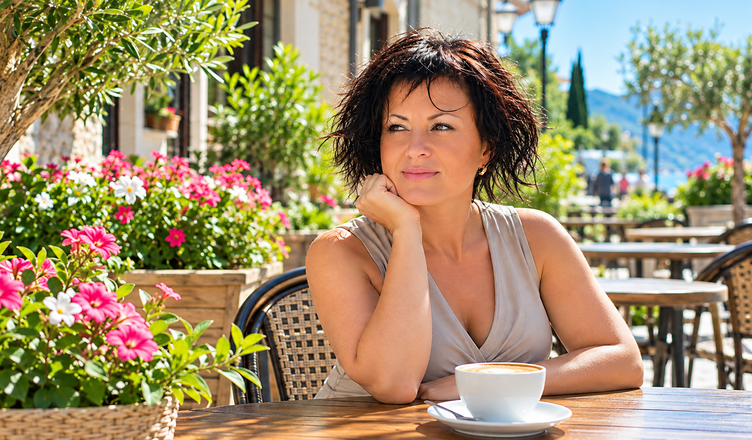
At forty, Marina believed that the most important decisions in her life had already been made. She was used to relying on herself, no longer planned too far ahead, and had accepted that some dreams might remain only dreams. But one trip completely changed the course of her life.
She met André by chance. He had come from another country for work and was significantly older—sixty-five. At first, the age difference seemed so large that Marina did not take their connection seriously. They talked, went for walks, argued about books and music, and gradually realized that they were beginning to look forward to every new meeting.
To other people, their relationship seemed unusual. Some assumed Marina was interested in financial security. Others thought André was simply going through a late-life crisis. The two of them tried not to let outside opinions define what they had.
But age was not the only problem.
André lived thousands of miles away. He had responsibilities in his own country, adult family members, property, work, and a life he had built over many years. Marina could not simply pack a suitcase either and start over somewhere unfamiliar.
Their relationship existed between flights, long phone calls, and constant conversations about whether a shared future was even possible.
A few months later, Marina discovered that she was pregnant.
At first, she reread the result of the test several times, almost hoping she had misunderstood it. Then she made an appointment with a doctor. There was no mistake.
She was pregnant.
Marina sat in her car outside the clinic for a long time, trying to understand what had just happened. Her first emotion was neither joy nor fear, but complete confusion.
She was forty years old. The father of the baby was sixty-five.
She immediately understood that many difficult questions lay ahead, and none of them could be answered in a single conversation.
When she told André the news, he was silent for several seconds.
Then he said he wanted to come see her.
A few days later, they met. For the first time in their relationship, they were not talking about feelings. They were talking about real life.
Where would the child live?
Who would support Marina during the pregnancy?
Was André ready to move?
Could Marina herself move to another country?
What would happen ten or fifteen years later, when the age difference between the parents might become even more noticeable?
None of those questions had an easy answer.
But the hardest part was something else.
Marina understood that, in the end, the decision would still be hers.
Advice from the people closest to her only made her more uncertain.
One friend told her that the baby could become the greatest joy of her life and that she should not give up the pregnancy simply because she was afraid of the future.
Another reminded her of the parents’ ages, possible medical risks, financial costs, and the uncertainty surrounding the relationship itself.
Marina’s mother did not pressure her. She said only one thing:
“Imagine each possible future separately. Don’t think about what other people expect from you. Think about which decision you will be able to live with yourself.”
That sentence made Marina look at the situation differently for the first time.
Until then, she had been asking herself only one question: “What is the right thing to do?”
Gradually, she began to understand that there might not be one universally correct answer.
Pregnancy after the age of forty often requires closer medical monitoring. Doctors usually assess the mother’s health, the progress of the pregnancy, and individual risk factors. But age alone does not automatically determine the outcome of a pregnancy. Decisions in such situations should be based on real medical information, the woman’s actual condition, and professional advice—not only on the fears of people around her.
The age of the future father also made Marina think seriously about the years ahead. She worried about how long André would be able to take an active role in the child’s life. At the same time, she understood something else: younger parents are not given guarantees of a long or completely predictable life either.
So gradually, the most important question stopped being the number in André’s passport.
What mattered more was whether he was truly ready to be a father.
Marina asked him to answer several questions as concretely as possible.
Was he prepared to spend most of the year with her?
Would he take part in everyday childcare, or would he simply visit a few times a year?
How would the child be financially protected if something happened to him?
How would they handle legal matters if the parents remained citizens of different countries?
The conversation was difficult.
André admitted that he had once imagined everything much more simply. He had thought that love itself would somehow solve the rest. Now he understood that feelings may be the reason two people decide to build a family, but family life also requires responsibility, planning, and a willingness to change long-established habits.
They began to approach the situation practically.
Marina met with her doctor and received information about the examinations and monitoring she would need.
André sought legal advice about recognition of paternity, the child’s citizenship, and inheritance matters.
They discussed finances, housing, and the possibility of living part of the year in one country before eventually making a permanent move.
The fear did not disappear after those conversations.
But there was less uncertainty.
After some time, Marina noticed an important change in the way she was thinking. Before, she had viewed the baby mainly as a problem forcing her to make a frightening decision. Now she began to imagine the child as a real person who might one day become part of her life.
And then another fear appeared: would she regret it years later if she made her decision only because everything felt too complicated right now?
At the same time, she understood that no woman should be expected to continue a pregnancy simply because of pressure from family, a partner, or society. Such a decision is too personal to be made for the sake of someone else’s approval.
In the end, Marina decided to keep the baby.
Not because André persuaded her.
Not because other people told her that it was the only correct choice.
She made the decision because she felt ready to become a mother even if life did not follow an ideal plan.
André began preparing to move.
Their future was still complicated. They would have to deal with distance, age, documents, healthcare, and the reactions of relatives.
But Marina began to see her situation differently.
She was no longer trying to obtain a guarantee that everything would turn out well.
Such guarantees simply do not exist.
Sometimes the hardest decisions in life are not choices between a good option and a bad one, but between two unknown roads.
In moments like these, it is especially important to separate real risks from other people’s fears, gather reliable professional information, realistically evaluate a partner’s support, and ask yourself the most difficult question:
“Which decision will still feel like mine even if no one else approves of it?”
Every person will have a different answer.
That is exactly why decisions like this should not be based only on age, public opinion, or a partner’s promises. They require time, clear information, and, above all, honesty with oneself.