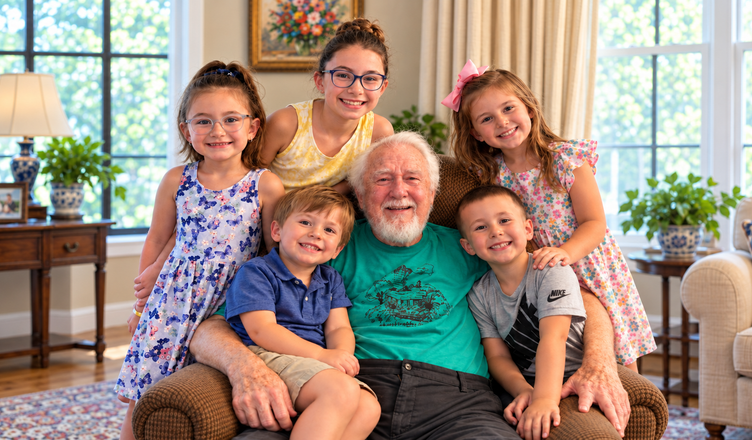
When an elderly man named Viktor Andreyevich moved into the house next door, we barely paid attention. He was eighty-eight years old, lived alone, rarely had visitors, and took a short walk around the neighborhood every morning. Sometimes we exchanged a few words by the gate, and sometimes he helped us carry heavy grocery bags into the yard. Back then, none of us could have imagined that this man would soon become almost part of our family.
We had five children, so silence was a rare thing in our home. Someone was always looking for a missing sock, someone else was arguing over toys, and the youngest always seemed to need attention at the exact moment dinner was about to burn. Viktor Andreyevich watched all that chaos with a smile.
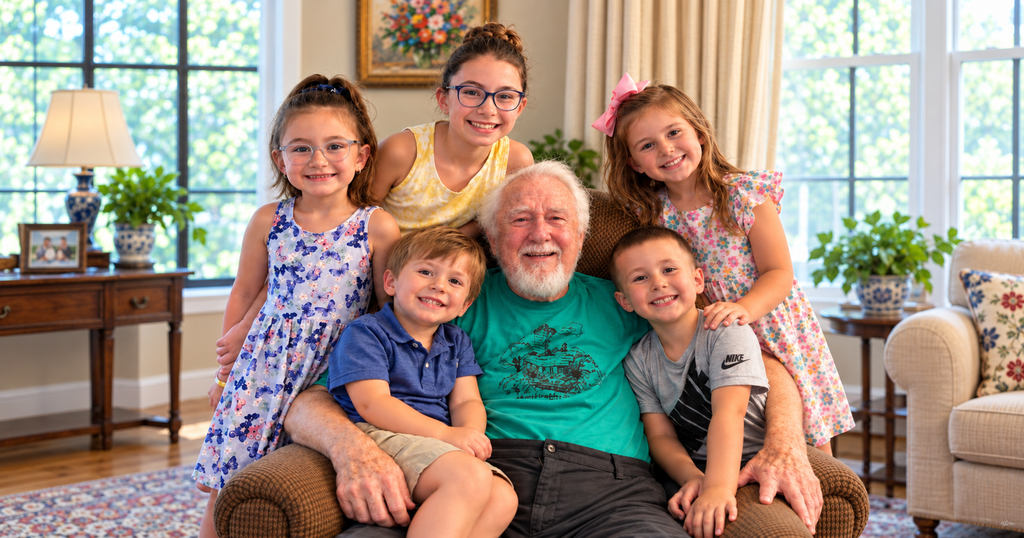
One evening, he came over to return a tool he had borrowed from my husband. We were just about to sit down for dinner, so we invited him to join us. At first, he refused, but the children began begging him to stay.
After that, dinners like that became a regular thing.
At first, once a week. Then more often. After a few months, no one even asked whether our neighbor would be coming that evening. We simply set an extra place for him at the table.
Viktor Andreyevich turned out to be an incredibly patient man. He could spend hours building things with the younger children, helping the older ones with homework, teaching our son how to repair his bicycle, and telling them stories about what the city had looked like decades earlier.
But what the children loved most were weekend mornings when he came to visit.
They would run to meet him before he even had a chance to knock.
“Grandpa Viktor is here!”
The first time I heard them call him that, I felt a little awkward. I was about to explain that he was not actually their relative, but Viktor Andreyevich only smiled.
“Let them call me whatever they want,” he said. “I like it.”
Almost two years passed this way.
Gradually, we stopped thinking of him as just our neighbor. If we went out of town, we invited him along. If we had a family celebration, we saved him a seat. When our youngest son became ill, Viktor Andreyevich came by several days in a row just to ask how he was doing.
He never asked for anything in return.
That was why, shortly before his eighty-ninth birthday, we came up with an unusual idea.
Our own parents lived far away, and the children had long since started thinking of Viktor Andreyevich as their grandfather. One day, our oldest daughter asked:
“Why can’t he be our real grandpa?”
That simple question made us stop and think.
We began looking into whether there was some legal way to formalize our relationship, to create documents that reflected what our family had already become in practice. The process turned out to be more complicated than we expected, so instead of preparing something final for his birthday, we put together a set of papers and an application that could begin the process.
We imagined his reaction very differently.
We thought he would laugh. Maybe cry. Perhaps he would say that at his age, it was a little late to become a grandfather officially.
On his birthday, the children baked a cake with me, drew cards, and waited in the living room for the moment when we would give him the gift.
Viktor Andreyevich sat at the table wearing a new shirt the children had given him. He looked happy.
My husband placed an envelope in front of him.
“This is from all of us.”
The old man opened it and began to read.
At first, his expression remained calm.
Then the smile disappeared from his face.
He reread the first page and then turned to the second.
His fingers began to tremble.
“What’s wrong?” I asked.
He didn’t answer.
For several seconds, Viktor Andreyevich simply stared at the documents. Then he slowly folded them and placed them back inside the envelope.
“Please send the children into another room.”
I immediately felt uneasy.
“Why?”
He looked up at us.
“Because before you officially make me part of your family, you need to know why I really moved in next door.”
My husband and I looked at each other.
Until that moment, it had never occurred to us to ask why an elderly man living alone had chosen that particular house. The neighborhood was ordinary, homes were rarely sold there, and Viktor Andreyevich almost never spoke about his past.
Once the children had left the room, he remained silent for a while.
Then he told us that many years earlier, he had been a close friend of my late father.
At first, I thought I had misheard him.
My father had died when I was still young. He rarely talked about the friends he had known in his youth, and I had never heard him mention anyone named Viktor.
But the old man knew details that no stranger could have guessed: the name of the village where my father had grown up, my grandfather’s old workshop, and even the family nickname that only relatives had used for my father.
It turned out that the two men had once been very close friends, but after a serious argument, they had stopped speaking. Viktor Andreyevich did not explain the reason in detail. He only said that pride had been involved, along with a few words both men later wished they could take back.
Many years later, he tried to find his old friend again, only to learn that my father had already passed away.
Eventually, by chance, he found me.
“Is that why you bought the house next to ours?” I asked.
He nodded.
But then he quickly added:
“I never intended to interfere in your life.”
According to him, at first he had only wanted to see the family of the man who had once been such an important part of his life. Maybe introduce himself, say something about the past, and then leave.
But he never found the courage to start that conversation.
Then came the first invitation to dinner.
Then the second.
Before long, the children were waiting for him at the window.
“At some point, I realized I wasn’t coming because of your father anymore,” Viktor Andreyevich said quietly. “I was coming because I had grown attached to all of you.”
He admitted that all this time, he had been afraid of one thing: that if he told us the truth, we would think his friendship with our family had been planned from the beginning.
Perhaps that was why the documents frightened him more than they pleased him.
We sat in silence for a long time.
I truly felt conflicted. It was uncomfortable knowing that he had hidden such an important part of the truth from us for almost two years.
But at the same time, I remembered hundreds of ordinary days.
No one had forced Viktor Andreyevich to wake up early to help the children build a bird feeder. No one had asked him to sit for hours beside a sick child. No one could have planned in advance all those small acts from which genuine closeness slowly grows.
The past explained why he had first appeared in our lives.
But it did not explain why he stayed.
After a while, the children peeked into the room again.
The youngest asked:
“Grandpa, didn’t you like our present?”
Viktor Andreyevich turned away, trying to hide his tears.
Then, for the first time that evening, he smiled.
We did not sign the documents that day. We decided that after a conversation like that, there was no reason to rush. We all needed time to process what we had just heard.
But at the birthday table, Viktor Andreyevich’s place remained exactly where it had always been.
And the next morning, as usual, the children ran to the window when they saw the familiar figure standing by the gate.
A family does not always begin with a shared last name or an official document.
Sometimes a person becomes part of it slowly — through shared breakfasts, repaired bicycles, bedtime stories, and hundreds of completely ordinary days.
The truth about the past can change many things.
But it cannot always erase what people have already built together.