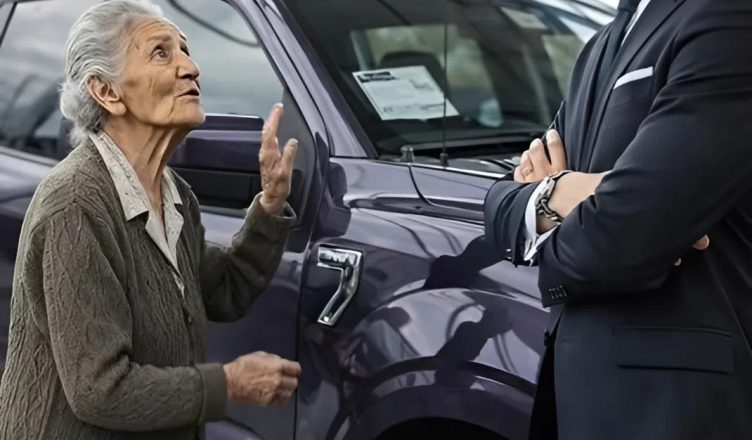
The manager stood frozen, as though he had suddenly lost the ability to speak. Just minutes earlier, he had allowed himself smirks, dismissive looks, and cutting remarks that stung like knives. And now — he couldn’t even meet her eyes.
But that wasn’t the worst part for him.
The worst part was the silence… and the looks.
The employees who had quietly laughed before were now avoiding eye contact. Some pretended to be busy with paperwork, others slipped out of the showroom entirely. The young employee — the one who had hesitated earlier — watched everything unfold with visible tension. In his eyes, it was clear: this wasn’t just an awkward moment. This was a collapse.
The woman slowly ran her hand across the car’s hood. She was no longer afraid. No longer uncertain. She didn’t feel out of place anymore.
“Proceed,” she said simply.
The man in the suit nodded immediately.
“Right away. And make sure there are no mistakes.”
His tone left no room for argument.
The paperwork process accelerated instantly. Documents shuffled, phones rang, keyboards clicked faster than usual. Everything felt rushed, almost frantic — as if the staff were trying to fix something that could no longer be undone.
But the woman didn’t rush.
She turned back.
“Tell me,” she asked, her voice unexpectedly gentle, “is this how you treat every customer?”
The manager flinched. He tried to respond, but the words caught in his throat.
“I… I didn’t know…”
“Of course you didn’t,” she replied calmly. “You didn’t even try to find out.”
A heavy silence filled the showroom.
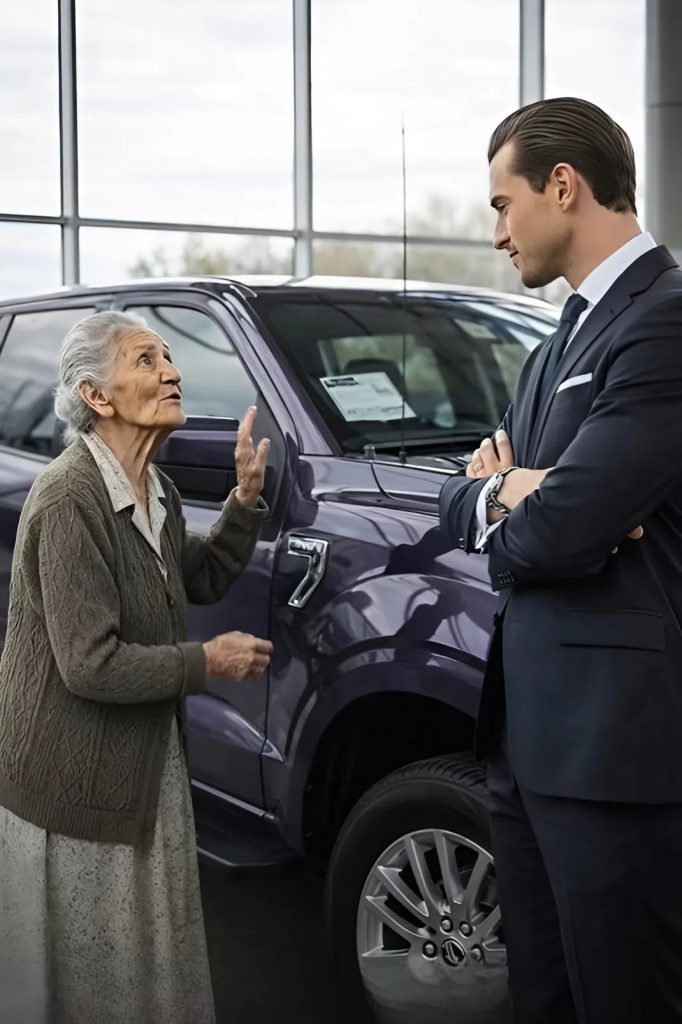
“You see,” she continued, “I worked for years. Many years. Not in an office. Not in a suit. With my hands. Sometimes at night. Sometimes without a single day off. All so that one day, I wouldn’t have to ask… but could choose.”
She spoke without drama, without complaint. Just facts — and that made her words even more powerful.
“But today, I learned something more important than any car.”
The manager slowly lifted his eyes. For the first time, there was fear in them.
“You showed just how easily a person can lose their dignity… even in an expensive suit.”
Her words echoed louder than any shout.
Someone quietly exhaled. Someone else lowered their head.
She no longer looked at him.
“I will still buy this car,” she said. “Not because of you. In spite of you.”
Everything was contained in that moment.
It wasn’t revenge. It wasn’t proof.
It was strength.
When the paperwork was finally complete, the man in the suit handed her the documents with a slight nod of respect.
“Everything is ready.”
She took them and carefully placed them into her old bag — the same one she had carried when she first walked in.
And somehow, that meant everything.
Nothing about her appearance had changed.
But everything around her had.
As she walked toward the exit, two employees rushed to open the doors for her. This time — with respect. With care. Almost with apology.
She left as quietly as she had entered.
But the silence she left behind was different.
No one spoke.
The manager stood alone in the middle of the showroom, surrounded by glass and polished metal, by luxury cars that suddenly felt empty.
He had lost.
Not a sale.
Something far more important.
And in that moment, everyone understood a simple but brutal truth:
sometimes a single look, a single word, a single moment of contempt can cost a person their career… their reputation… and the kind of respect no amount of money can ever buy.