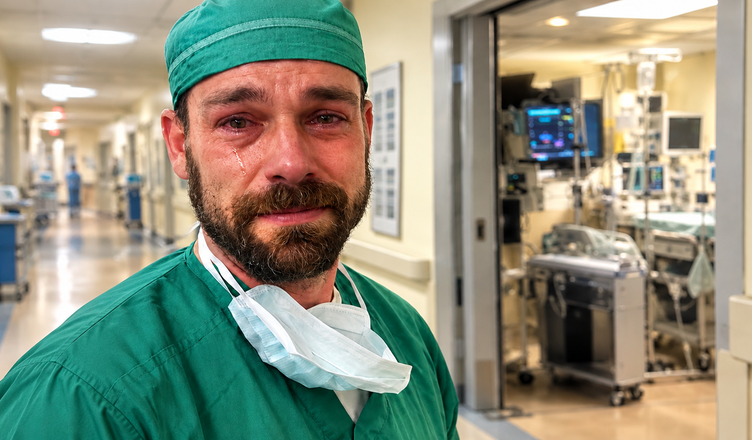
On Friday morning, I decided to surprise my husband.
There was no special occasion. Over the past few weeks, he had simply been coming home later than usual, looking exhausted and talking almost constantly about work. He said the company had started a difficult new project, management was demanding reports almost every day, and employees were staying at the office late into the evening.
I believed him.

We had been married for eleven years. During that time, we had been through a lot: moving, financial difficulties, illnesses in the family, and arguments over small things. But I had always believed there was one thing that would never come between us — serious secrets.
On the way, I bought two coffees and a box of his favorite pastries. I imagined how surprised Andrei would be when he saw me standing outside his office.
At the entrance to the business center, the security guard asked for the employee’s name.
“Andrei Vorontsov, logistics department.”
My husband had told me about his workplace many times, but I had never visited before.
For some reason, the guard looked at me more carefully than I expected. Then he made a phone call and gave me a visitor pass.
I went up to the fourth floor.
Behind the glass doors was a large, bright office. Several people were talking near the coffee machine, others were sitting at their computers, and a few employees were walking between desks with folders in their hands.
I stopped a woman who looked to be in her early thirties.
“Excuse me, could you tell me where Andrei Vorontsov’s office is?”
She looked at me and visibly went pale.
“Are you a relative?”
I smiled.
“I’m his wife.”
The woman froze.
It lasted only a second, but it was enough for me to realize that something was wrong.
She quickly glanced around and asked,
“What’s your name?”
“Irina.”
Her expression changed even more.
“Wait here.”
She walked over to a nearby desk and quietly said something to a man wearing glasses. He looked up, glanced at me, and immediately looked away.
A few moments later, the woman came back.
“Can we speak somewhere private?”
By then, I was starting to feel nervous.
“Why?”
She did not answer. Instead, she led me into a small meeting room.
After closing the door, she stood silently for a few seconds, as if deciding whether she should tell me anything at all.
“My name is Lena. I’ve worked with Andrei for almost four years.”
“All right. Where is he?”
She lowered her eyes.
“He hasn’t told you anything?”
The question sounded so alarming that my hands suddenly felt cold.
“Told me what?”
Lena looked at me, and tears appeared in her eyes.
“Irina, I’m sorry. I thought you knew.”
I placed the coffee cups on the table.
“What am I supposed to know?”
She took a deep breath.
“Andrei doesn’t work here anymore.”
At first, I did not even understand what she meant.
“What do you mean, he doesn’t work here?”
“He hasn’t for almost two months.”
I laughed. Not because anything was funny. Sometimes people laugh simply because they do not know how else to react.
“That can’t be right. He comes here every morning.”
“You’re not mistaken. I’m not either.”
Then Lena told me something I had never expected to hear.
About two months earlier, the company had lost a major client and had to lay off several employees. Andrei had been one of them. His coworkers knew how badly he had taken it. For several days afterward, he still came to the office to finish paperwork and hand over his responsibilities.
But then something strange happened.
About a week after he was laid off, some of his former colleagues began seeing him near the building. Every morning, he would arrive wearing a suit, sit in a café across the street, and spend hours there with his laptop.
Sometimes he even came into the building under the excuse of meeting someone he knew.
“He asked us not to tell you anything,” Lena said. “He kept saying he would find another job soon and explain everything himself.”
My hands began to shake.
For the past two months, Andrei had gotten up every morning at seven, ironed his shirt, placed documents into his briefcase, and said,
“Today is going to be another difficult day.”
In the evenings, he told me about meetings.
New clients.
A boss who had forced him to redo a report.
Now I understood that all of it had been invented.
But Lena had not finished.
“He was terrified of going home without a job,” she said quietly. “Not because he was afraid of you. I think he was ashamed to admit to himself that he had been fired.”
I suddenly remembered several things that had seemed unimportant at the time.
Andrei had stopped using his work laptop.
He had begun watching our expenses very carefully.
Several times, he suggested postponing the kitchen renovation.
And once, in the middle of the night, I found him sitting on the balcony. He told me he simply could not sleep.
Now all those small details formed a completely different picture.
“Then where does he go every day?” I asked.
Lena was silent for a moment.
“As far as I know, he’s looking for work.”
It turned out Andrei had not been sitting around doing nothing. One former colleague had seen him going to interviews. Another had helped him improve his résumé. He had even done a few small projects for companies he knew.
He was not living a double life.
There was no other woman.
No secret family.
No criminal story.
The truth was much simpler and, in some ways, more painful: my husband had spent two months pretending that nothing had changed because he was afraid to admit that he had failed.
I took the coffee and left the office.
I did not call Andrei immediately.
Instead, I went home and spent several hours thinking about everything I had learned.
Losing his job was not what hurt me most.
Anyone can lose a job. It happens to thousands of people.
Something else hurt much more.
For eleven years, we had believed we were the kind of couple who could tell each other anything. Yet when Andrei found himself in a truly difficult situation, he chose to hide behind an invented life.
Around seven that evening, the front door opened.
My husband came in as usual. He put down his briefcase, took off his jacket, and said tiredly,
“Today was awful.”
I was sitting in the kitchen.
The same box of pastries was on the table.
Andrei saw it and stopped.
I think he understood everything before I even said a word.
“I went to your office today.”
He slowly sat down across from me.
For several seconds, neither of us spoke.
Then he covered his face with his hands.
“I’m sorry.”
I could have shouted.
I could have accused him of lying.
I could have listed every fake meeting, every invented report, and every supposed late night at work.
Instead, I asked only one question.
“Why didn’t you tell me?”
He stared at the table for a long time.
After he was fired, Andrei had been certain he would find another job quickly. He decided not to tell me for a few days.
Then a week passed.
Then another.
He kept getting rejected after interviews.
And with every passing day, telling the truth became more difficult.
“I kept thinking, as soon as I get an offer, I’ll tell you everything. I’ll just say I was changing jobs. But the offer never came.”
“Didn’t you trust me?”
“I did. That was exactly why I was afraid.”
At first, the answer made no sense to me.
Later, I understood what he meant.
Some people do not hide their problems because they have bad partners or unkind families. They hide them because they are used to seeing themselves as strong, and they are afraid of seeing disappointment in the eyes of the person whose opinion matters most.
That does not justify lying.
But sometimes it explains it.
We talked until nearly midnight.
For the first time in two months, Andrei told me how many interviews he had attended, how many rejections he had received, how much money we had left, and why he had become so careful about spending.
We decided that from then on, we would stop hiding difficult things from each other.
Three weeks later, Andrei found a new job. The salary was a little lower than before, but the company was more stable, and the commute was shorter.
Still, the biggest change had nothing to do with his career.
After everything that happened, we both understood something we had always considered obvious without ever thinking deeply about it.
Closeness is not tested when everything is going well.
Real trust begins at the moment when a person can look at someone they love and say:
“I failed.”
Sometimes the most dangerous secret in a family does not begin with betrayal.
Sometimes it begins with the fear of looking weak in front of the one person you most want to see you as strong.