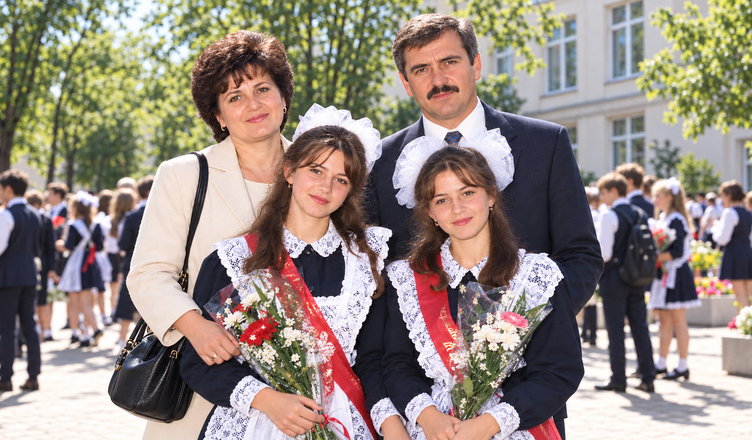
For thirty years, Marina kept the same photograph in the bottom drawer of her dresser. It showed an ordinary family moment: a summer picnic in the yard, a folding table, a few plates of fruit, her husband standing by the grill, and two teenage daughters laughing near the garden gate.
Once, the picture had been nothing more than a happy memory. Later, it became almost unbearable to look at.
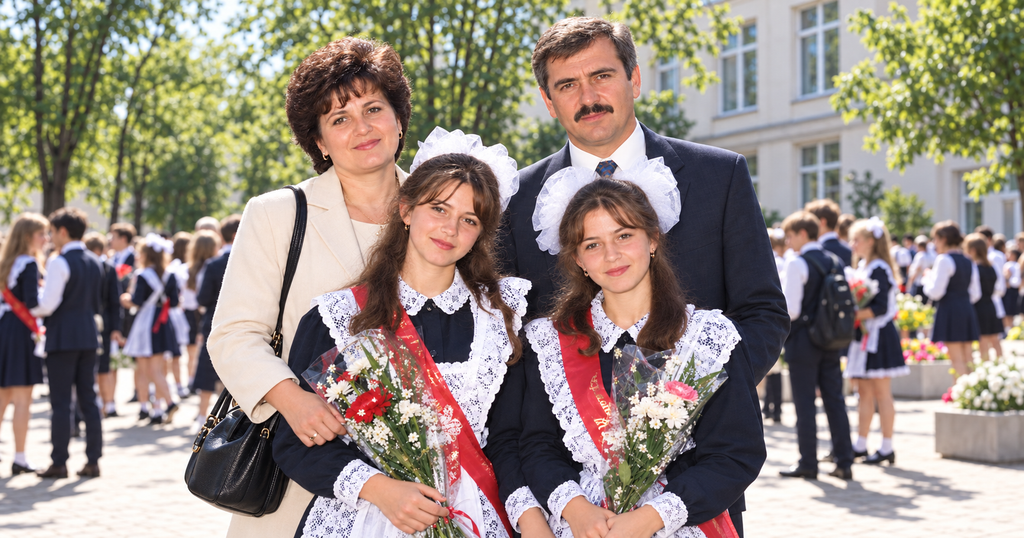
Four months after that picnic, her daughters, sixteen-year-old Lena and seventeen-year-old Olga, went to a school dance and never came home.
Nothing about that evening seemed unusual. The girls spent a long time choosing what to wear, argued over the mirror, and went back to their room several times because they had forgotten a handbag, a hair clip, or bus money.
Marina remembered the final minutes almost second by second.
“Don’t stay out too late,” she told them.
Lena laughed and said they were not little children anymore.
Olga promised to call if the event ended later than expected.
Then the door closed.
Marina never saw her daughters again.
By midnight, she was worried. At one in the morning, she called one of Olga’s friends. The girl confirmed that the sisters had been at the school event, but they had left before it was over.
No one could say for certain where they had gone.
Some students remembered seeing them near a bus stop. Others said they had planned to visit an all-night café. Someone else mentioned a car parked not far from the school.
Police followed dozens of leads.
They searched the surrounding area, abandoned buildings, and a wooded strip outside town. Teachers, classmates, and family acquaintances were questioned. Investigators also looked into people the girls might have been meeting without their parents knowing.
Nothing conclusive was found.
Several times, people came forward claiming they had seen the sisters in nearby towns. Marina traveled there herself, put up photographs at bus stops, and spoke with shopkeepers, bus drivers, and hotel employees.
Every time, hope ended the same way.
It was not them.
A year passed. Then another.
Marina’s husband gradually stopped believing their daughters would ever return. He never said it directly, but she could feel it.
Their marriage did not survive what happened.
A few years later, they separated.
Marina remained alone in a house where everything reminded her of the past. For a long time, she could not bring herself to change her daughters’ rooms. Schoolbooks still stood on the shelves, dresses hung in the closet, and an unfinished note remained in a notebook on Olga’s desk.
As the years passed, the investigation nearly came to a standstill.
No new leads appeared. Witnesses forgot details. Some people moved away, and others died.
The case was never officially closed, but in practice it became one of those mysteries revisited only when new information surfaced.
To Marina, that distinction meant very little.
She kept waiting.
From time to time, strangers called and claimed they knew what had happened to the girls. Some demanded money for information. Others told unbelievable stories.
After several such experiences, Marina stopped answering calls from unknown numbers.
Thirty years passed.
One day, her nephew suggested digitizing the old family photographs. The paper prints were beginning to fade, and he was afraid that some of them might become impossible to preserve.
Marina agreed.
They spent an entire evening scanning pictures.
When they reached the photograph from the summer picnic, her nephew noticed that the digital copy had come out unusually clear.
“You can enlarge almost anything in this one,” he said.
Marina instinctively zoomed in on the part of the image where her daughters were standing.
She stared at their faces for a long time.
Then she shifted the picture slightly to the right.
Beyond the garden gate, part of the street was visible.
She had never paid much attention to that area before. On the original paper photograph, the background had been too small and blurry.
Now some details were easier to make out.
A light-colored car was parked across the street.
Marina frowned.
She enlarged the image further.
A man was standing near the vehicle.
His face was impossible to recognize, but another detail was surprisingly visible.
There was a large dark sticker of an unusual shape on the rear door.
A chill ran through Marina.
She had seen that symbol before.
Years earlier, during the original investigation, one witness had mentioned a light-colored car near the school on the night the girls disappeared. At the time, the description had seemed too vague: an older sedan, a man behind the wheel, no remembered license plate.
But the witness had mentioned one unusual feature.
There had been a strange sticker on the rear door.
Police had looked into the report, but the car was never identified.
Marina opened the boxes where she had stored old case documents.
She had kept almost everything connected to the investigation: newspaper clippings, copies of reports, investigators’ names, and witnesses’ phone numbers.
After several hours, she found the note she was looking for.
The description matched.
“Light-colored car. Dark symbol on the rear door, resembling a bird or a wing.”
Marina looked at the photograph again.
The shape on the car really did resemble an outstretched wing.
That raised an important question: why had the same, or a very similar, car been near their home months before the girls disappeared?
Of course, it could have been a coincidence.
After thirty years, memory can give meaning to details that may have had nothing to do with what happened.
Marina understood that.
She did not try to find the owner of the car herself, and she did not post the photograph online. Instead, she contacted the police department where the old case files were stored.
At first, her report was treated cautiously.
But after investigators received the original photograph along with the old case materials, they agreed to examine it again.
The license plate could not be recovered.
However, an expert confirmed that the vehicle in the photograph appeared to be roughly the same type and age as the one described in the original witness statements.
That alone proved nothing.
There was still no evidence that the car had anything to do with the sisters’ disappearance.
Then, a few weeks later, an investigator called Marina.
Another old statement had been found in the archives, one that had received very little attention thirty years earlier.
Several days before the school dance, a neighbor had noticed a similar car near the family’s home.
According to his statement, the driver had remained there for some time, watching the street before eventually driving away.
Why these details had not been connected at the time was impossible to say with certainty. The original investigation had produced hundreds of notes, statements, and theories.
Now the case was being reviewed again.
Investigators began searching old vehicle registration records, checking previous owners, and looking through archived insurance files.
Marina was warned immediately that the new lead might still go nowhere.
Thirty years is a very long time.
The car may have been scrapped decades ago. Records may have been lost. And even if the former owner could be identified, that person might have had nothing at all to do with the girls’ disappearance.
Still, something had happened that Marina had almost stopped hoping for.
The investigation had a specific direction again.
She did not know whether it would lead to an answer.
Perhaps the car would turn out to be nothing more than a coincidence.
Perhaps it was connected to something no one had noticed decades earlier.
But the old photograph was no longer just a memory of the family’s last happy summer.
It had become a reminder that sometimes a tiny detail can remain in plain sight for years without anyone truly seeing it.
Marina placed the original photograph back inside its envelope.
This time, beside it was a digital copy enlarged enough to clearly show the light-colored car at the edge of the image and the small dark symbol on its door.
For thirty years, Marina had asked herself the same question:
What happened to my daughters?
For the first time in a very long while, there was another question beside it:
Who had been near their home before the girls disappeared?