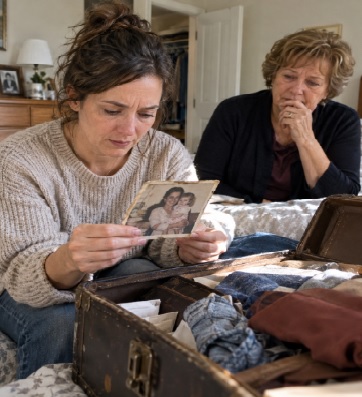
For three years after my husband died, I barely touched his belongings. Not because I hoped that one day I would see him again. I knew perfectly well that would never happen. Some of his things simply felt like the last boundary between the life we had shared and the new reality in which I had to learn to live alone.
His jackets were still hanging at the back of the wardrobe. On a shelf lay the watch he used to take off every night before going to bed. And on top of the closet sat an old brown suitcase.
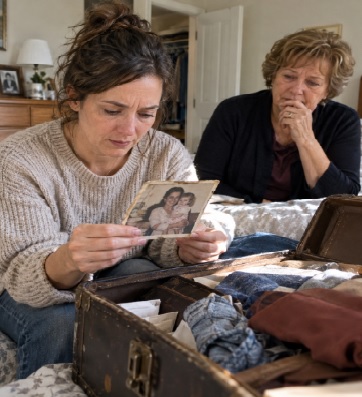
Several times, I had thought about opening it, but I always found a reason to put it off.
One Saturday, I finally decided to sort through the apartment. I wanted to donate some things, throw others away, and keep the most meaningful belongings for our children.
When I reached the suitcase, I placed it on the bed and opened its tarnished metal clasps.
There seemed to be nothing unusual inside: a few old shirts, some documents, a notebook, chargers for phones that had stopped working years ago, and a folder filled with papers. I was about to close the suitcase when I noticed that the bottom seemed strangely thick.
Beneath the fabric lining, I discovered a narrow hidden pocket.
Inside was a single photograph.
The picture showed a woman I had never seen before. She appeared to be in her early thirties. Beside her stood a boy of about five or six. The child was looking directly at the camera while the woman smiled slightly.
I turned the photograph over.
A date from almost twenty years earlier was written on the back.
Below it was an address.
My address.
More precisely, it was the address of the house where my husband and I had spent most of our married life.
I sat on the edge of the bed for a long time, trying to find a simple explanation. Perhaps the woman was a relative. Maybe she had once been our neighbor. Perhaps my husband had received the photograph by chance and simply forgotten about it.
But then why had it been hidden beneath the lining of the suitcase?
And why was our home address written on the back?
I barely slept that night.
The next day, I called my mother-in-law. She was already over eighty, and I didn’t want to discuss something like this over the phone. I simply told her that I had found an old photograph among her son’s belongings and wanted to ask her about it.
When I arrived, she immediately noticed the envelope in my hand.
We sat down in the kitchen. I placed the photograph in front of her.
Her reaction was immediate.
She didn’t ask who the people in the picture were. She didn’t need to examine the date or the address. She simply removed her glasses and stared silently out the window for several seconds.
At that moment, I understood.
She knew them.
“Who are they?” I asked.
For a long time, she said nothing.
Then she quietly replied:
“I hoped you would never have to find out about this.”
My first thought was infidelity.
The most painful explanation immediately formed in my mind: my husband had another woman, perhaps even a child whose existence had been hidden from me.
But the truth was different.
The woman in the photograph was named Marina. Many years earlier, she had been the partner of my husband’s younger brother. They had planned to marry, but the wedding never happened. My husband’s brother died in a car accident before his son was born.
After his death, Marina was left alone with the child.
At first, the family helped her, but over the years they gradually lost contact. Only my future husband continued to stay in touch with her. He believed he had a responsibility to help his nephew, if only because the boy’s father would never be able to do it himself.
“Then why did he never tell me?” I asked.
My mother-in-law lowered her eyes.
The situation, it turned out, was more complicated.
By the time my husband and I married, Marina was already living in another city. She didn’t want to interfere in our family life and had very little contact with her late fiancé’s relatives. Still, she visited a few times with her son.
On one occasion, they stopped outside our house.
That was when the photograph had been taken.
My husband himself had written the address on the back. He wanted the boy to know, once he was older, where he could find his father’s relatives.
But one important question remained.
Why had the photograph been hidden?
My mother-in-law didn’t know for certain.
According to her, my husband had intended to tell me about his brother, Marina, and his nephew one day, but he kept postponing the conversation. Perhaps he was afraid I would misunderstand why he had been helping another woman for so many years. Perhaps he considered the story too personal and painful to discuss.
Those were only assumptions.
He was no longer there to explain his decision.
I returned home with even more questions.
Over the following days, I couldn’t stop thinking about the boy in the photograph. If my mother-in-law’s story was true, he would now be around twenty-five years old.
I went through my husband’s documents again and found an old notebook. Among dozens of phone numbers was one with only the letter “M” written beside it.
The number was no longer in service.
So I tried to find Marina through old family acquaintances. After several weeks, I learned that she had moved away. Eventually, someone gave me the contact details of a man whose name matched that of my husband’s nephew.
For several days, I couldn’t bring myself to write to him.
Finally, I sent a short message. I introduced myself and explained that I had found an old photograph that I believed showed him and his mother.
His reply came almost immediately.
He really was the boy in the picture.
But something else surprised me even more.
He knew my husband very well.
It turned out that they had remained in contact all those years. My husband hadn’t only helped him financially. They spoke on the phone, met whenever they had the opportunity, and talked about his studies, his work, and his future.
For this young man, my husband had been the last living connection to the father he had never known.
“He often talked about you,” the young man wrote. “And he always said he had a wonderful family.”
I read those words several times.
They warmed my heart and hurt at the same time.
The man I had shared so many years with had managed to keep such an important part of his life completely hidden from me. It was difficult to accept that he had never trusted me with this story.
Gradually, however, I began to see everything differently.
There was no second family hidden behind the photograph. There had been no secret affair or betrayal, as I had feared at first. Instead, there was an old tragedy, a sense of responsibility toward a deceased brother, and a boy for whom my husband had tried for many years to be the family member he had lost.
I didn’t begin to idealize my husband after discovering the truth. His silence still hurt. Even good deeds can leave painful consequences when they are surrounded by a wall of secrecy for years.
A few months later, I finally met the boy from the photograph.
Of course, he was no longer a child. A grown man sat across from me. He had brought several photographs of my husband that I had never seen before.
In one, they were fishing together.
In another, they were standing outside a university on the day he was accepted.
We talked for almost three hours.
Before we parted, I handed him the photograph I had found in the suitcase.
At first, he refused to take it.
But I insisted.
For me, that photograph had been the beginning of a mystery.
For him, it was part of his family’s history.
When I returned home, I closed the old suitcase for the first time in three years without feeling that familiar heaviness in my chest and moved it off the bed.
The belongings of those we have lost don’t always preserve only the memories of what we experienced together. Sometimes they can reveal entire chapters of their lives that we never knew existed.
And not every secret hides a betrayal.
Sometimes, behind a secret lies a promise that someone quietly kept for many years.