
Ten years of marriage had taught Anna and Michael not to ask each other one particular question anymore: “When will it finally happen?”
During the first few years, they were certain they would eventually have a child. Then came medical examinations, consultations, treatments, and long months of waiting. Each new attempt brought fresh hope, only for it to gradually turn into disappointment.
One day, Anna finally said something she had been thinking about for a long time.
“Maybe our family is simply meant to begin in a different way?”
That was the first time they seriously discussed adoption.
It wasn’t an impulsive decision. They spent a long time talking about whether they were truly prepared to welcome a child with a past of his own, along with his personality and fears. One thing worried Anna in particular: she never wanted the child to feel that they had adopted him out of pity.
Several months later, they met a three-year-old boy named Arthur.
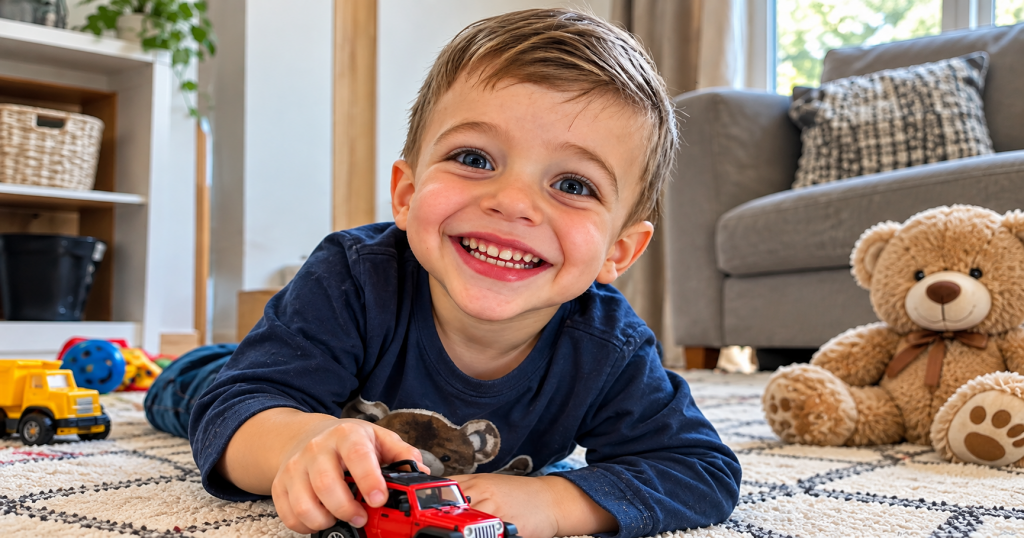
During their first meeting, he barely spoke. He sat on the edge of a chair, clutching a small toy car to his chest and carefully watching the adults around him.
Anna didn’t immediately try to hug him. Instead, she sat a short distance away and began putting together a wooden puzzle. A few minutes later, Arthur moved closer. Then, without saying a word, he handed her one of the pieces.
That small gesture meant more to her than words ever could.
Michael also made sure not to rush things. He looked through picture books with Arthur, rolled toy cars across the table with him, and patiently waited for the boy to become comfortable around him.
When all the necessary procedures were finally completed and Arthur came home with them, Anna felt for the first time that their years of waiting were over.
They had prepared his bedroom in advance. There were toys and books on the shelves and a bedspread decorated with cars. But what fascinated Arthur most was the small lamp beside his bed. He switched it on and off several times, almost as if he were checking whether he was really allowed to use the things in this room.
The first day passed peacefully.
That evening, Michael offered to give their son his bath.
“You’ve been with him all day. Get some rest. I can handle it.”
Anna smiled and went to the kitchen to prepare dinner.
For several minutes, she could hear water splashing in the bathroom. Then everything suddenly went quiet.
At first, Anna didn’t think much of it. But then she heard her husband call her name.
“Anna!”
There was something in his voice that made her immediately put down the knife she was holding.
“What happened?”
There was no answer.
She hurried into the bathroom and found Michael standing beside the tub. Arthur was sitting in the water, holding a little toy boat against his chest.
Michael had gone completely pale.
“We have to take him back,” he said quietly.
For several seconds, Anna simply stared at him, unable to understand what she had just heard.
“What did you say?”
Michael didn’t answer. He simply pointed toward the boy’s back.
Anna stepped closer.
There were several old scars on Arthur’s skin. A few small marks were near his shoulder, while others were lower down his back. It was obvious that they weren’t recent.
Anna felt a chill run through her.
Almost immediately, however, her fear turned into anger.
“You want to give up our child because of some scars?”
Michael looked sharply at her.
“No. That’s not what I mean.”
He lowered his voice so Arthur wouldn’t hear him.
“I want to take him back there tomorrow. Not to leave him. I want to find out why nobody told us about this and how a three-year-old child ended up with these marks.”
Anna fell silent.
A single sentence spoken in panic had sounded far more terrible than Michael had intended.
That evening, they decided not to question Arthur. They understood that demanding answers from such a young child, who had only just arrived in an unfamiliar home, would be wrong.
After the bath, Anna helped him put on his pajamas and tucked him into bed.
She was about to leave the room when Arthur suddenly asked:
“Will I still be here tomorrow?”
Anna stopped.
“Of course.”
“And the day after tomorrow?”
She returned to the bed and sat beside him.
“The day after tomorrow too.”
The boy looked at her for several seconds, as if trying to decide whether he could trust her answer. Then he turned toward the wall and closed his eyes.
The following morning, the couple contacted the professionals who had assisted with the adoption process and requested all available information about Arthur’s health and background.
They discovered that some of the information had indeed appeared in his medical records. However, either the details had not been fully explained to them or they had failed to understand the significance of certain notes. The older documents also made it impossible to determine with certainty how each scar had been caused.
So they decided not to make assumptions.
They took Arthur to a doctor. The main conclusion reassured them: old scars alone did not mean that the boy’s health was currently in danger. What mattered more was monitoring his condition and gradually creating a safe and predictable environment for him.
That was when Anna began to understand just how easily adults can underestimate the importance of an adopted child’s past.
A child does not arrive in a new family as a blank page.
Even at three years old, a child already has experiences of his own. He may not remember specific events, but he can remember feelings: fear of a raised voice, anxiety when a door closes, the habit of hiding food, or the fear of being left alone. Some behaviors may seem strange to adults until they understand that those same behaviors may once have helped the child feel safer.
The first few weeks with Arthur were not easy.
He sometimes woke during the night to check whether someone was nearby. Occasionally, he hid pieces of bread in his pockets. Several times, he asked how long he would be allowed to stay in the house.
Anna and Michael never tried to force him to tell them about his past.
Instead, they focused on showing him what his present could be.
Every morning followed a familiar routine: breakfast, washing up, getting dressed. In the evening came dinner, quiet playtime, a bath, and a story before bed. When his parents promised they would come back, they came back. When they said they would return in a few minutes, they kept their word.
Gradually, Arthur’s questions became less frequent.
Several months later, Michael was once again giving his son a bath. Arthur laughed, sailed his toy boat across the water, and demanded that his father make “the biggest wave ever.”
Anna stood in the doorway and remembered their first evening together.
Back then, Michael’s words — “We have to take him back” — had sounded like the end of their family.
In reality, they marked the beginning of an important realization.
Adoption does not erase the life a child lived before meeting his new parents. A loving family cannot change the past, but it can help ensure that the past no longer determines every day that follows.
Later, Anna came to understand something else.
That first evening, she had been frightened by the scars she could see on her son’s body. But the more important scars were the ones no one could see.
And those were the ones that took the longest to heal.
It took time before Arthur stopped asking whether he would still be there tomorrow. Then one evening, Anna suddenly realized that she hadn’t heard that question in a very long time.
For her, it became one of the most important moments in their life as a family.
Not because the boy had forgotten his past.
But because he had finally stopped being afraid of his future.